

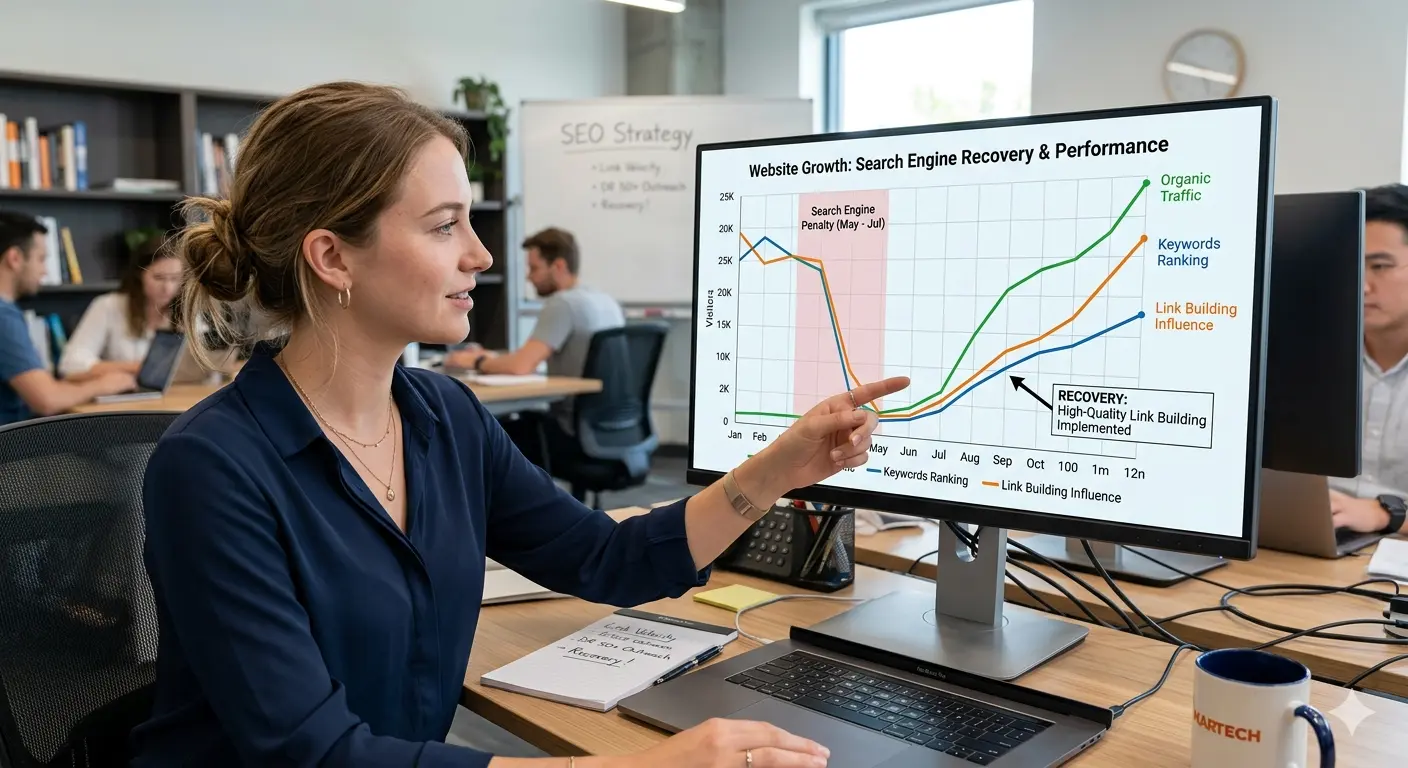
To recover from a Google penalty using guest posting, you must replace toxic or low-quality links with high-quality, relevant authority signals. By securing high DA guest posting placements and using manual outreach guest posting, you signal to search engines that your site is once again associated with trustworthy, human-vetted content providers.
Quick Answer (TL;DR)
You can fix a Google penalty by auditing your current link profile, disavowing "spammy" links, and launching a campaign for white hat guest posting. Success hinges on obtaining dofollow guest posts from premium guest posting sites that have real traffic, which helps rebuild the "TrustFlow" that Google stripped away during the penalty phase.
The Reality of the "Google Slap"
I’ve seen it happen dozens of times. One day you’re sitting on page one for your best keywords, and the next, you’ve vanished. Maybe you used an automated tool, or perhaps you hired an agency that promised "1,000 links for $50." Whatever the cause, your site is now in the digital equivalent of a Witness Protection Program.
Here’s the thing: you can't just delete the bad links and hope for the best. Recovery requires a proactive infusion of high authority backlinks. In my experience, a strategic shift toward guest posting services that prioritize quality over quantity is the only way to show Google you’ve changed your ways. It’s about rebranding your site’s reputation in the eyes of the algorithm.
What Is a Link-Based Google Penalty?
Google Penalty: A manual or algorithmic suppression of a website’s search rankings caused by violations of webmaster guidelines, usually related to deceptive link-building or thin content.
When we talk about recovery, we’re usually dealing with Penguin-related issues or manual actions for "unnatural links." This happens when your backlink profile looks like a graveyard of PBNs and irrelevant directory submissions. To fix it, you need a guest post agency that understands niche guest posts—placements on sites that actually talk about what you do.
Why Guest Posting for SEO Still Dominates in 2026
What most people overlook is that search engines have become incredibly good at detecting "intent" and "user engagement." In 2026, a link isn't just a vote; it’s a path. If no one is clicking that path, the link carries almost zero weight.
Premium guest posting sites are valuable because they have actual readers. When you buy guest posts that are placed within high-quality, editorial content, you aren't just getting a backlink. You're getting referral traffic and brand mentions. This "human signal" is what helps lift the shadow of a penalty. If real people are engaging with your brand on high-authority platforms, Google assumes your site must be worth showing again.
How to Use Guest Posting to Fix Your Rankings — Step by Step
Identify and Prune the Toxic Roots Before you start new outreach, you have to clean house. Use a tool to identify every link with a high "spam score." I’ve seen sites try to build their way out of a penalty without disavowing first—it’s like trying to fill a bucket that has a giant hole in the bottom.
Audit Your Anchor Text Diversity Most penalties stem from "over-optimization." If 70% of your links use your primary keyword as the anchor text, you’re asking for trouble. When you start your new guest post outreach, focus on branded anchors (Your Brand Name) or naked URLs.
Source Real Niche Relevance Don't just look for high DA; look for topical relevance. If you sell organic dog food, a link from a high-DA tech blog is "okay," but a link from a modest-DA pet health site is gold. This is where manual outreach guest posting becomes your best friend.
Create "Hero" Content for the Placements Stop sending 500-word "top 5 tips" articles. If you want to recover, you need to provide the host site with content that is better than what they usually publish. I'm talking 1,500 words, original data, and professional formatting.
Drip Feed the New Links Don't go from zero links to fifty in a week. That looks unnatural. A steady, consistent growth of high authority backlinks over three to six months is the pace Google expects from a recovering site.
The Counterintuitive Secret: Why "Lower DA" Can Be Better
Here’s a hot take that might surprise you: sometimes a DA 30 site is more valuable for penalty recovery than a DA 80 site.
Why? Because many DA 80+ sites have become "link farms" that accept almost any guest post for a fee. Google knows this. On the flip side, a smaller, tightly moderated community blog with a loyal audience (even if the DA is lower) provides a much stronger "neighborhood" signal. In my 10 years of doing this, I’ve found that a mix of high-authority sites and smaller, hyper-relevant niche blogs creates the most "human" link profile possible.
Expert Tips for Lasting Success
Let me be direct: there are no shortcuts here. If you're looking to buy guest posts, make sure the provider isn't just putting you on a site they own. You want a partner that does the hard work of building relationships with third-party editors.
Expert Tip: Always check the "Outbound Link Ratio" of a potential guest post site. If every single article on their blog links out to a different commercial website, Google likely views that site as a "guest post seller." Avoid those. You want sites where guest posts are the exception, not the rule.
Best Press Release Submission Platforms for SEO & Brand Visibility
While guest posting builds deep topical authority, press release distribution sites provide the wide-reaching foundational signals that a recovering site needs. When you launch a new initiative or "rebrand" after a penalty, using a reputable press release agency allows you to get your story on major news outlets quickly.
These PR submission sites generate a massive amount of "no-follow" and "do-follow" signals simultaneously, which looks incredibly natural to search algorithms. It mimics a real-world news event. By utilizing news distribution platforms, you can secure brand mentions on high-authority domains that are virtually impossible to get through standard outreach. This online PR marketing approach acts as a "trust buffer," surrounding your targeted guest posts with a sea of legitimate, news-based citations. The result is a more balanced and resilient link profile that can withstand future algorithm updates.
People Most Asked about Guest Posting for Recovery
Can guest posting really lift a manual action?
Yes, but only after you’ve submitted a reconsideration request. The guest posts act as the "proof of quality" that you present to the Google reviewer to show you are now committed to white-hat practices.
How many guest posts do I need to see a recovery?
It's not about a magic number; it's about the ratio. If you have 500 bad links, 5 amazing guest posts won't cut it. You usually need enough high-quality links to make the "spammy" ones look like a small, historical anomaly rather than your current strategy.
Is dofollow better than nofollow for recovery?
While dofollow guest posts pass the "link juice" needed for rankings, a few nofollow links from high-traffic sites add to your profile's authenticity. A profile that is 100% dofollow looks suspicious to modern AI filters.
Should I use my main keywords in the guest post content?
Absolutely, but keep them in the body of the text for topical context. Use the anchor text (the actual link) for your brand name or the title of the article you are linking to.
How long does recovery take?
In most cases, you’re looking at 3 to 6 months. Google needs to crawl your new, high-quality links multiple times and see that the "bad" links are gone or disavowed before they recalculate your site's trust score.