

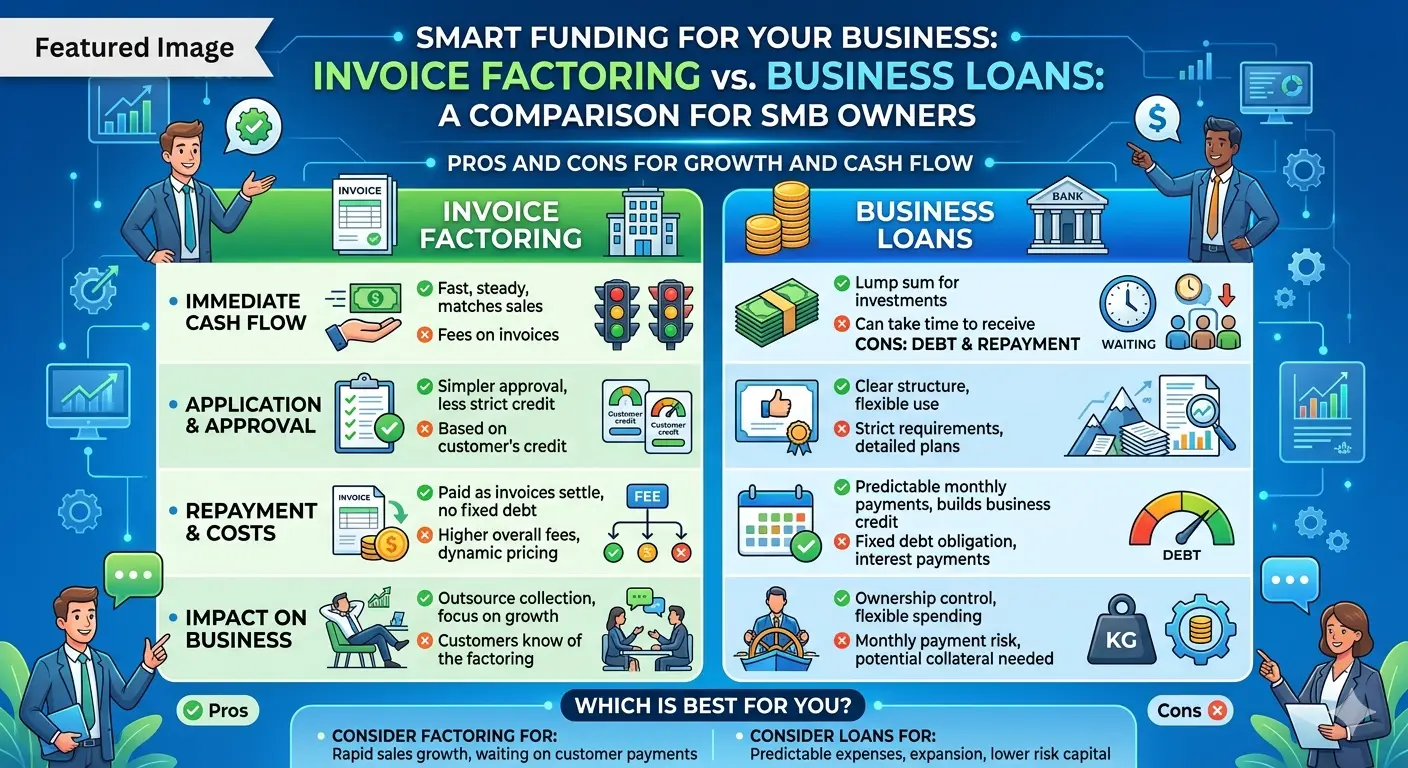
Quick Answer: If you need immediate liquidity to cover a gap caused by unpaid customer invoices, invoice factoring is your best bet. If you require a lump sum for long-term expansion or large-scale inventory buys, a traditional business loan is usually the smarter play. The choice depends on whether your cash flow problem is a timing issue or a total capital shortage.
Whether you're running a boutique agency or a growing e-commerce brand, you’ve likely hit that wall where you want to scale—perhaps by investing in high-quality Guest Posting Services—but your cash is tied up in 30, 60, or 90-day invoices. It’s frustrating. You have the money on paper, but you can’t use it to pay for the Guest Post Backlinks that would actually drive your SEO forward.
I’ve spent over a decade watching businesses struggle with this exact fork in the road. In my experience, most owners jump into debt when they should have just unlocked their own earned money. Let’s break down the mechanics of these two financial tools and see which one helps you hit your growth targets without sinking the ship.
Quick Answer (TL;DR): Invoice factoring gives you instant cash by selling your outstanding invoices at a small discount, making it perfect for quick marketing spikes like High DA Guest Posting. Business loans provide a larger, upfront sum with fixed interest, which is better for permanent infrastructure. Choose factoring for speed and loans for long-term stability.
What Is Invoice Factoring?
Invoice Factoring: A financial transaction where a business sells its accounts receivable to a third party at a discount to get immediate cash.
Think of it as a cash advance on work you’ve already finished. You’ve delivered the goods or services, sent the bill, and now you’re just waiting. A factoring company steps in, buys that invoice, and gives you about 80% to 90% of the value right now. Once your customer pays them, they send you the remaining balance, minus a small fee.
It isn't a loan because you aren't borrowing money; you’re selling an asset. This distinction is huge for your balance sheet. If you’re looking to Buy Guest Posts to boost your site authority, factoring allows you to use your own revenue to fund it rather than taking on a new monthly interest payment.
Why Cash Flow Management Matters in 2026
The business environment in 2026 is faster than ever. Algorithms change overnight, and if you can't fund a Guest Post Outreach campaign the moment a trend hits, you're going to lose market share to more agile competitors.
Wait-and-see is a dying strategy. I've noticed that the most successful SMBs treat cash flow as a tactical weapon. They don't just use it to keep the lights on; they use it to seize "white hat" opportunities. Having liquid capital means you can hire a Guest Post Agency during a seasonal dip when prices might be more competitive, or secure Premium Guest Posting Sites before your rivals catch on.
How to Choose the Right Funding — Step by Step
Choosing between these two isn't about which is "better" in a vacuum. It’s about which fits your current stress point.
Audit Your Receivables: Look at your aging report. Are your customers reliable but slow? If you have $50k sitting in 60-day invoices, factoring is an easy win.
Define the Goal: Is the money for a one-off project like Niche Guest Posts to support a product launch? Or is it for a new warehouse? Use factoring for the former and loans for the latter.
Check Your Credit: Traditional loans require a high personal and business credit score. Factoring relies more on the creditworthiness of your customers.
Calculate the Total Cost: Compare the factoring fee (usually 1-5%) against the annual percentage rate (APR) of a loan. Sometimes the "expensive" factoring is actually cheaper because you only pay for the weeks you need the cash.
Review the Impact on Debt: If you plan to sell your business soon, having too many active loans can lower your valuation. Factoring keeps your debt-to-income ratio clean.
The Big Misconception: Factoring Is Only for Failing Businesses
Here is a hot take that most financial advisors won't tell you: Factoring is often a sign of too much success, not failure.
Most people assume that if you're "selling" your invoices, you're desperate. That’s nonsense. In reality, I see healthy companies use factoring because they are growing so fast their cash flow can't keep up with their sales. If you just signed three major clients and need to scale your Manual Outreach Guest Posting immediately to keep up with the demand for results, factoring is the smartest way to bridge that gap.
Using a loan to cover a temporary growth spurt is like using a sledgehammer to hang a picture frame. It's overkill and might leave a permanent mark on your finances.
Expert Tips: What Actually Works for SMB Growth
In my decade-plus of handling SEO and digital strategy, I've seen that the best results come from "velocity." Cash velocity is how fast you can turn a dollar of revenue back into a dollar of marketing.
If you use Guest Posting for SEO, you know that the results aren't instant. It takes time for those High Authority Backlinks to register and for your rankings to climb. Because of this lag, you need a funding source that doesn't put you in a chokehold.
My advice? Use factoring for your recurring marketing expenses. It keeps your Guest Post Link Building consistent. Use business loans only when you’re making a structural change to your business that will take years to pay off. What most people miss is that a loan creates a "fixed" cost, while factoring is a "variable" cost. In a volatile market, you want as many variable costs as possible so you can pivot when needed.
Best Press Release Submission Platforms for SEO & Brand Visibility
Once you've sorted your cash flow, one of the most effective ways to use that liquidity is through high-impact press release distribution sites. Many business owners focus solely on blogs, but a well-timed announcement through a professional press release agency can create a surge of "dofollow" authority that standard articles might miss.
Using PR submission sites provides a different flavor of backlink—one that signals "news-worthiness" to search engines. These news distribution platforms help in creating a diverse link profile, which is a key component of White Hat Guest Posting strategies. The benefit of online PR marketing is twofold: you get the direct traffic from the news cycle and the long-term SEO value from the High Authority Backlinks generated by the syndication.
People Also Asked About This Topic
Does invoice factoring hurt my relationship with customers?
Not necessarily, though it depends on the "notice of assignment." Most modern companies are used to paying factors. As long as the factoring company is professional, it won't be an issue. In many cases, it makes you look more established because you have a formal accounts receivable process.
Is a business loan cheaper than factoring in the long run?
Usually, yes. If you have great credit, a bank loan will almost always have a lower total cost of capital. However, the "cost" of a loan includes the time spent applying and the risk of collateral. Factoring is more expensive per dollar but significantly more flexible.
Can I use factoring for Guest Post Outreach expenses?
Absolutely. Since marketing is an investment in future revenue, using current (but locked) revenue to pay for it is a classic growth hack. It allows you to maintain your Guest Posting Services without dipping into your emergency cash reserves.
What happens if my customer doesn't pay the factored invoice?
It depends on if you have "recourse" or "non-recourse" factoring. In recourse factoring, you have to buy the invoice back or replace it. In non-recourse, the factoring company takes the loss. Non-recourse is more expensive but offers more peace of mind.
How fast can I get funds from a business loan compared to factoring?
Loans can take weeks or even months to clear the red tape. Factoring can often be set up in a few days, and once you're in the system, individual invoices can be funded within 24 hours. For urgent Guest Post Backlinks needs, speed usually wins.
Do I need collateral for invoice factoring?
The invoices themselves are the collateral. Unlike a traditional loan where you might need to put up your house or equipment, factoring only puts your accounts receivable at risk. This makes it a much lower-risk option for many small business owners.