

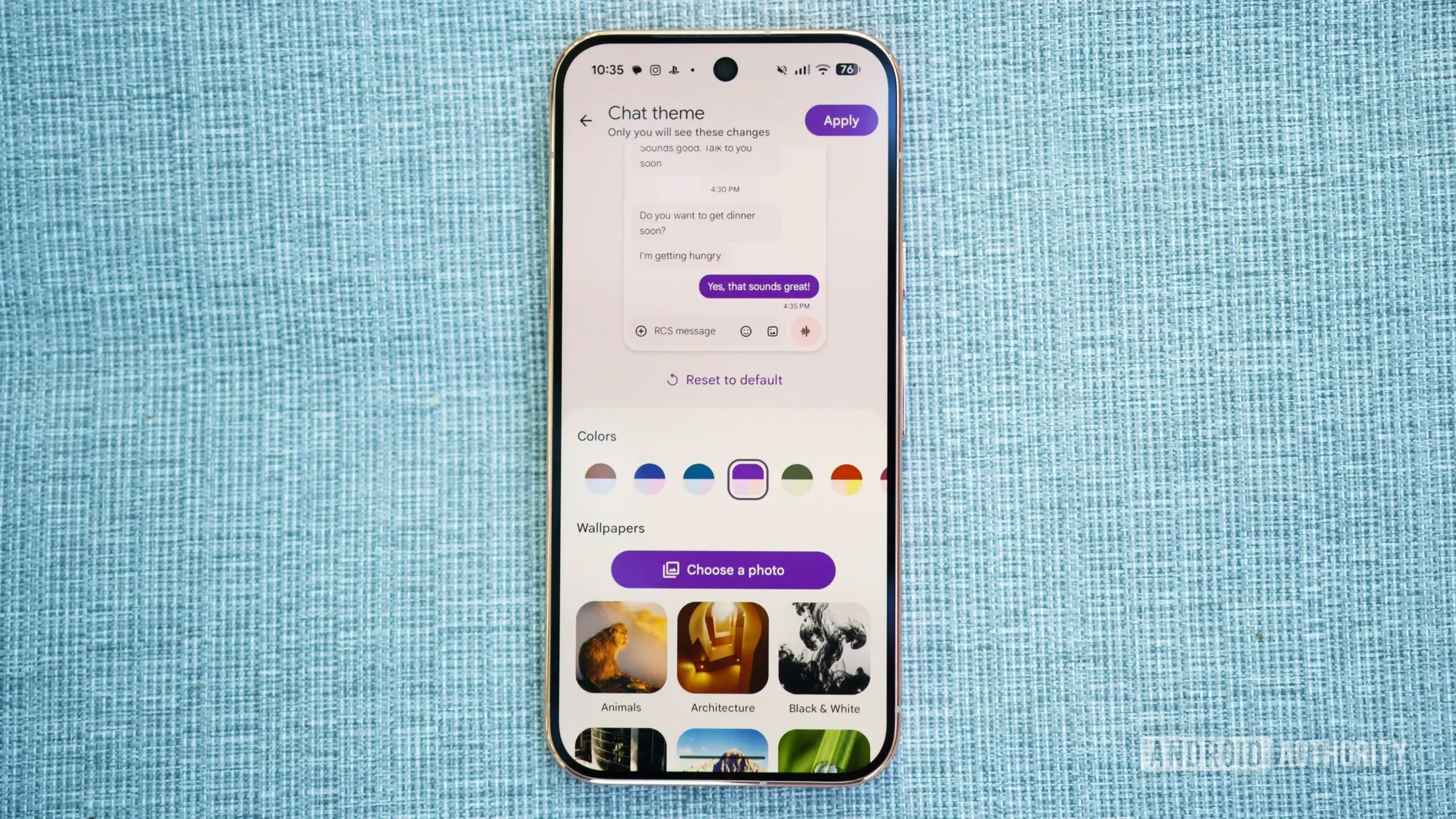
Customization has long been one of the defining pillars of Android. From launchers to icon packs, from always-on displays to lock-screen widgets, Android users are used to making their devices feel unmistakably their own. Google Messages has historically remained more restrained, with basic accent colors and light or dark mode choices. That changed with the recent introduction of chat themes, a feature designed to bring the same level of personal expression to one of the most-used apps on the phone: the default messaging client.
The new chat themes allow you to assign a distinct visual identity to each conversation. You can pick a color scheme, choose one of Google’s preset wallpapers, or use an image from your own photo library. If the built-in color selection feels limiting, the background image can effectively transform the conversation into something far more personal. The entire look is applied within a thread, rather than globally, which means a work conversation can remain professional and clean while the family group chat gets a chaotic collage of holiday snaps.
How Google Messages chat themes work
Chat themes are built into individual conversation threads, and they work alongside Google’s broader push to make Messages more expressive. When you open a chat and head to the settings or customization menu, you can now switch up the overall look. The themes are compatible primarily with RCS chats, Google’s modern replacement for SMS, although the visual layer does not interfere with message delivery or read receipts.
One of the more interesting design decisions is that themes are only ever visible on your end. The person you are chatting with will not see your carefully selected background or bubble color unless they happen to choose the same one themselves. That means the feature is much more about making the app feel personal to you than about broadcasting style to the world. For some, that is a welcome dose of privacy, especially when compared to the world of customized chat stories and profile themes used by other apps. For others, it makes the whole exercise feel less social and more like interior decorating for a room only you will ever visit.
What the poll revealed
To gauge enthusiasm for the feature, a poll was put to readers shortly after Google unveiled chat themes. The poll attracted more than 2,500 votes, and the final split was remarkably close across the three main options. The largest group, 36% of voters, said they had been waiting a long time for chat themes. A second group, 33%, admitted they were unsure about the feature but planned to try it anyway. The smallest but still substantial slice, just over 31%, said they would never use the feature.
That does not provide a landslide mandate. If anything, it shows that Google Messages users are genuinely split between those who see themes as a natural evolution of the Android experience and those who view them as unnecessary visual noise. However, the numbers also reveal that nearly 70% of respondents are either enthusiastic or at least open-minded enough to give the feature a chance. That suggests there is real appetite for conversation-level personalization, even if it was not the most loudly requested feature in the history of Android messaging.
It is also worth remembering that the remaining third of voters may not be speaking about Google Messages itself. Many readers outside the United States have long gravitated toward third-party messaging services such as WhatsApp, Telegram, Signal, and similar platforms. In those apps, text messages are often used for little more than delivery alerts or one-time passwords. Legacy SMS and even RCS versions of texting have never gained the same cultural foothold in many regions as Apple’s iMessage has in North America. For those users, chat themes in Google Messages are an irrelevant detail, because Google Messages is not their daily driver.
Reader reactions: love it, hate it, and want more
Beyond the raw poll numbers, the comments section was just as revealing. Some users happily reported that the new themes were working seamlessly. One commenter, Kennyg357, said the themes were functioning and looking great on their Galaxy Z Fold 6. They welcomed finally having the option on Android after years of seeing similar features in other messaging apps. That echoes a sentiment often heard among Android enthusiasts: the operating system encourages flexibility, and Google should bring that flexibility to its own first-party apps.
Others were less impressed, but for a different reason. Another commenter, Shear.it.up, wanted more granular control rather than simply applying a preset theme. They asked for the ability to apply one theme to every contact at the same time, and they wanted to be able to choose bubble colors freely. This points to a broader truth about customization features: once a company opens the door, users immediately ask for more power over the pixels. A single background image and a slightly different accent color are just a taste test for people who have already spent years rearranging their home screens.
Then there were those who could not understand the fuss. Toddster1111 dismissed chat themes as meaningless window dressing. That phrase may sound harsh, but it captures a legitimate perspective. At its core, a messaging app exists to send and receive messages quickly and reliably. Visual theming does nothing to improve signal strength, reduce battery drain, or make conversations more efficient. Yet fans of personalization would counter that the entire Android ecosystem is built on meaningful choices about appearance and feel. By that measure, a chat theme is not so different from choosing a wallpaper that brightens your day or a ringtone that makes you smile before you answer.
Launch issues and Google’s response
The rollout of chat themes has not been entirely smooth, and a number of readers used the comment section to report problems. One user named Jandyfrix said they were unable to set up a theme after two days of trying. A couple of other readers reported that Google Messages froze whenever they entered or left the theme picker. For a feature designed to be a delightful little addition, those kinds of bugs can quickly turn the experience sour.
Google has acknowledged the instability. The company responded to queries by saying that availability may fluctuate as it optimizes the rollout. It also said it was looking into reports of latency and freezing, which should reassure users who have already grown accustomed to the feature and just want it to work reliably. Soft launch problems are common in the world of Android, especially when a feature is tied to server-side flags and gradual rollouts. Still, it serves as a reminder that personalization only feels good when it does not get in the way.
Why this matters in the wider messaging world
Google Messages has become central to Google’s push for a more modern messaging ecosystem. After years of fragmented attempts with services like Hangouts, Allo, and Duo, Google has consolidated on Messages as its default Android offering. RCS has played a major role in that effort, bringing read receipts, typing indicators, high-resolution media sharing, and improved group chats to the classically stale SMS experience. The arrival of chat themes is part of that broader strategy, making RCS conversations feel more like modern chat apps and less like green bubble carryovers from the 1990s.
The timing is also notable. Apple finally brought RCS support to iPhones with recent iOS updates, which means Android and iPhone users can now share many of the richer messaging features that were once exclusive to Apple’s walled garden. Google’s decision to add cosmetic features like chat themes before the cross-platform RCS rollout is complete may seem curious, but it speaks to how deeply the company wants Messages to be an everyday hub for self-expression, not just a utility pipe.
Of course, not everyone is convinced that chat themes will attract new users to Google Messages. Third-party apps have offered bubble colors and custom backgrounds for years. WhatsApp and Telegram both feature extensive theming capabilities, often paired with dynamic wallpapers and chat folders. Google is not breaking new ground here; it is catching up. The poll suggests that catching up was enough for a large share of existing users, especially those who have wanted the feature for a long time. But the roughly one-third who said they would never use chat themes may simply be uninterested in any of these extras, no matter how polished they become.
The bumpy rollout and the mixed poll results also reinforce an important lesson about feature development. Not every announcement needs to be a revolutionary moment. Some features are meant to bring delight to a subset of users while leaving everyone else to continue using the app as they always have. Google Messages already lets users choose their own wallpaper in a limited fashion for some chat styles, but the new themes aim to make that a central, easily discoverable option rather than a buried trick. Whether that effort lands depends on how quickly Google fixes the current bugs and whether it follows up with even deeper customization controls like the ones readers requested.
The split in opinion also mirrors broader debates about how far personalization should go in everyday technology. Some people love changing every aspect of their digital environment. Others prefer an interface that gets out of the way and lets them focus on communication. Google’s polls and comment threads are useful because they show that neither side is monolithic. The 33% who are unsure but willing to try the feature may end up being the decisive group. If themes work flawlessly and impress through their variety, some of those uncertain users will become regulars. If the feature continues to freeze and crash, the 31% who said they would never use it might be proven right in their expectations.
For now, Google Messages users can continue experimenting with the new themes wherever the rollout has reached. Device manufacturers like Samsung have also started to adopt RCS fallbacks, allowing the feature to appear on phones beyond the Pixel lineup. The good news is that themes are not intrusive. They do not change message ordering, do not alter the read receipts rules, and do not force recipients to view them. As Google smooths out the early issues, the question may shift from whether chat themes were worth introducing to how much deeper the customization can go. After all, Android has never been known for asking its users to accept one narrow idea of beauty.
Source: Android Authority News