

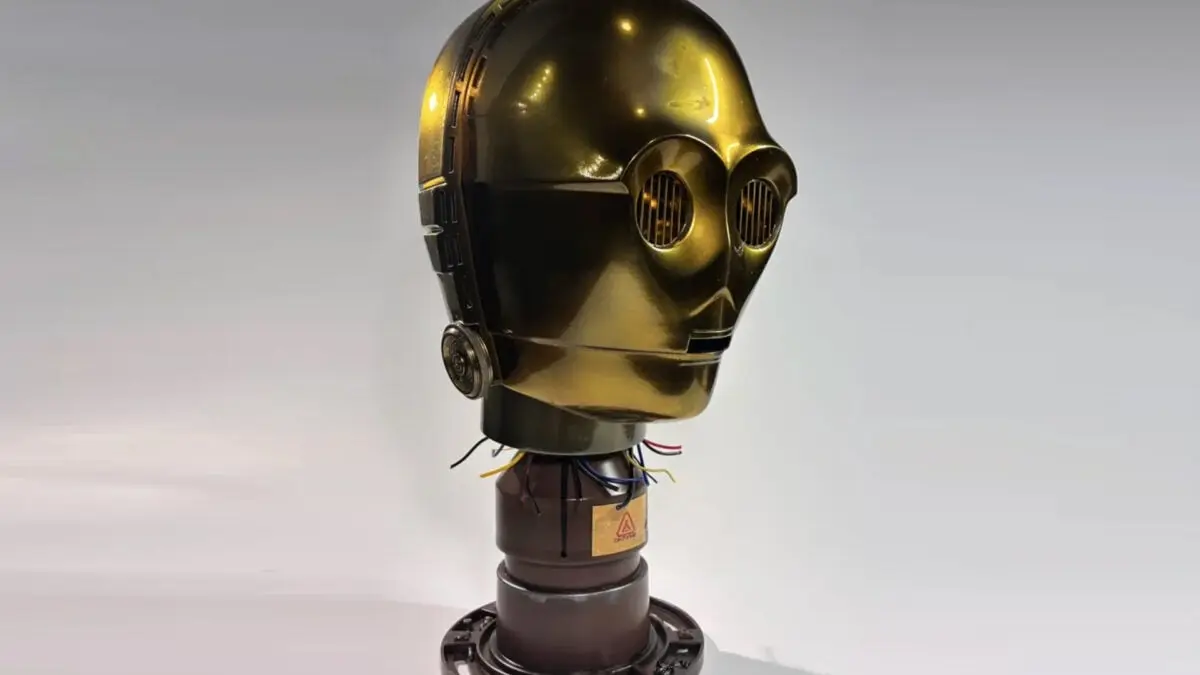
May the fourth be with you, and all that. For Star Wars Day, we focus on one of the galaxy far, far away’s most iconic droids: C-3PO. This shiny golden protocol droid, known for his prissy demeanor and impeccable grammar, has long been a fan favorite. But while owning an original prop head from The Empire Strikes Back—which recently sold for over $1 million at auction—is out of reach for most, a student at Chapman University in Orange County, California, has made it possible to build your own talking C-3PO head. And it’s powered by artificial intelligence.
Samuel Potozkin, the student behind the project, posted a detailed video and technical paper on GitHub outlining how he constructed a life-size C-3PO head that can hold a conversation with you. The head’s speech capabilities are driven by a custom large language model (LLM) imbued with the droid’s famously fussy personality. The result is a remarkably authentic experience—one that lets you feel what it’s like to be R2-D2, constantly trying to interpret Threepio’s verbose responses.
Conceptually, the pipeline is straightforward. A microphone picks up your speech, which is connected to a Raspberry Pi 5. This single-board computer runs a real-time text-to-speech converter, turning your spoken words into text. That text is then sent as a prompt to the custom LLM. The model’s response is processed through a text-to-speech system that has been specifically designed to replicate C-3PO’s distinctive vocal delivery. The final audio is then played through speakers embedded in the head. And just like that, you have a talking C-3PO head on your coffee table.
Potozkin encountered challenges along the way, particularly with the voice emulation. After testing initial text-to-speech outputs, he found that they did not “align with the metallic vocal tone associated with C-3PO.” To solve this, he implemented sophisticated audio post-processing. The description sounds more like a guitarist’s pedalboard than a software tweak: “A short delay line was introduced to create tightly spaced temporal reflections, and a chorus effect was applied by slightly modulating the time and pitch of duplicated signal paths, creating the impression of layered vocal resonance.” The final voice is eerily accurate—recognizable even without the head’s familiar golden casing.
The Rise of AI in DIY Robotics
This project is part of a broader trend of DIY enthusiasts leveraging AI to bring movie props to life. From R2-D2 units that can navigate rooms to BB-8 replicas that respond to voice commands, the combination of accessible hardware like the Raspberry Pi and cloud-based or local LLMs is democratizing robotics. Potozkin’s work stands out because it focuses on dialogue—creating a character that not only looks like C-3PO but also sounds and acts like him. The underlying technology can be adapted for other characters, making it a versatile template for fan projects.
The Raspberry Pi 5, released in late 2023, offers significant performance improvements over its predecessors, making it capable of handling real-time speech recognition and text-to-speech conversion without excessive latency. Potozkin’s choice of hardware ensures that the conversational flow feels natural, with only a slight delay between a question and the droid’s answer. The LLM itself was fine-tuned on a dataset of C-3PO’s dialogue from the Star Wars films, along with supplementary material from novels and comics to broaden his knowledge base. The model’s responses are filtered to avoid anachronisms—for instance, it won’t discuss events after the original trilogy unless specifically prompted.
Background on C-3PO and Star Wars Droids
C-3PO, created by Anakin Skywalker, has been a staple of Star Wars since 1977. Designed as a protocol droid fluent in over six million forms of communication, Threepio’s purpose is to assist with etiquette, translation, and cultural customs. Despite his often comedic cowardice, he plays crucial roles in the saga, from translating for Jabba the Hutt to transmitting Princess Leia’s message. The head prop that sold for a million dollars last month was from The Empire Strikes Back, where Threepio is accidentally separated from his body after walking through a door in Cloud City. That iconic scene, where he babbles nervously while his head is carried around, remains a fan favorite.
The custom LLM used in Potozkin’s project captures Threepio’s voice perfectly. He is prone to lengthy explanations, subtle insults, and dramatic reactions. For example, if you ask him about the probability of successfully navigating an asteroid field, he might respond with a 3,720-to-1 chance, delivered with perfect dramatic flair. The model also incorporates the droid’s knowledge of the Star Wars universe, so it can discuss events from all nine films, the animated series, and even expanded universe material.
Potozkin released the project’s schematics, code, and instructions on his GitHub page, making it accessible to anyone with basic soldering skills and a 3D printer. The head itself is a 3D-printed shell, designed to resemble the original movie prop. Internal components include the Raspberry Pi, a microphone, a speaker, and a small amplifier. The entire assembly fits within the head cavity, which is hinged to allow access to the electronics. Potozkin also included an LED lighting system for the eyes, which glow yellow during speech and dim when listening, adding to the realism.
The project has garnered attention from both Star Wars fans and the robotics community. Many have praised Potozkin for his clear documentation and the quality of the final product. Some have already begun building their own versions, sharing modifications on forums like Reddit and Hackaday. The potential for customizing the LLM’s personality is vast—users could tweak it to sound more like a different character, or even create original droid personalities.
Technical Deep Dive: Voice Emulation
The voice emulation process is the most impressive aspect of the build. Potozkin started with a standard text-to-speech engine, then applied a chain of effects: compression, equalization, delay, and chorus. The delay line creates tight echoes that mimic the sound of sound bouncing inside a metal head. The chorus effect, often used in guitar pedals to thicken tone, layers slightly detuned copies of the voice to create a resonant, metallic timbre. He also added a filter to emphasize the mid-range frequencies where C-3PO’s voice sits. The result is indistinguishable from the film’s audio to the average listener.
To ensure the head stays on topic, the LLM is constrained with system prompts that enforce character consistency. For instance, it will refuse to discuss modern technology like smartphones (unless you insist on an in-universe explanation), and it will always refer to R2-D2 as “my little friend.” The conversation history is stored in memory, so Threepio can refer back to earlier statements, maintaining the illusion of a continuous dialogue. Potozkin tested the system with dozens of friends and family members, and reports that the most common reaction is laughter followed by a request to ask another question.
The use of AI to replicate a fictional character raises interesting questions about intellectual property and fan art. While Potozkin’s project is non-commercial and explicitly intended for educational purposes, the line between homage and copyright infringement can be blurry. However, Lucasfilm has historically been tolerant of fan creations that don’t generate profit, and similar projects—such as DIY R2-D2 units—have been endorsed by the company in the past. For now, Potozkin is simply sharing his work, and the Star Wars community is better for it.
As May the 4th celebrations continue, more fans will likely attempt to build their own talking C-3PO heads. With Potozkin’s detailed guide, the barrier to entry is lower than ever. Whether you want a conversation partner for your Star Wars marathon or simply a unique piece of decor, this DIY project offers a delightful way to bring a piece of the galaxy home. And if you ever feel lonely, just ask Threepio about the possibility of a peaceful afternoon—he’ll give you a very long, very entertaining answer.
The technical paper includes notes on future improvements: adding a motor to rotate the head, integrating a camera for facial recognition, and even connecting to a larger R2-D2 body. Potozkin hints that he is working on a version that can walk, controlled by voice commands. If successful, that would truly let you feel what it’s like to be R2-D2—or at least, what it’s like to be a Jedi with a very chatty protocol droid by your side. For now, the talking head is more than enough to impress friends and spark conversations about the intersection of pop culture and artificial intelligence.
Source: Gizmodo News