

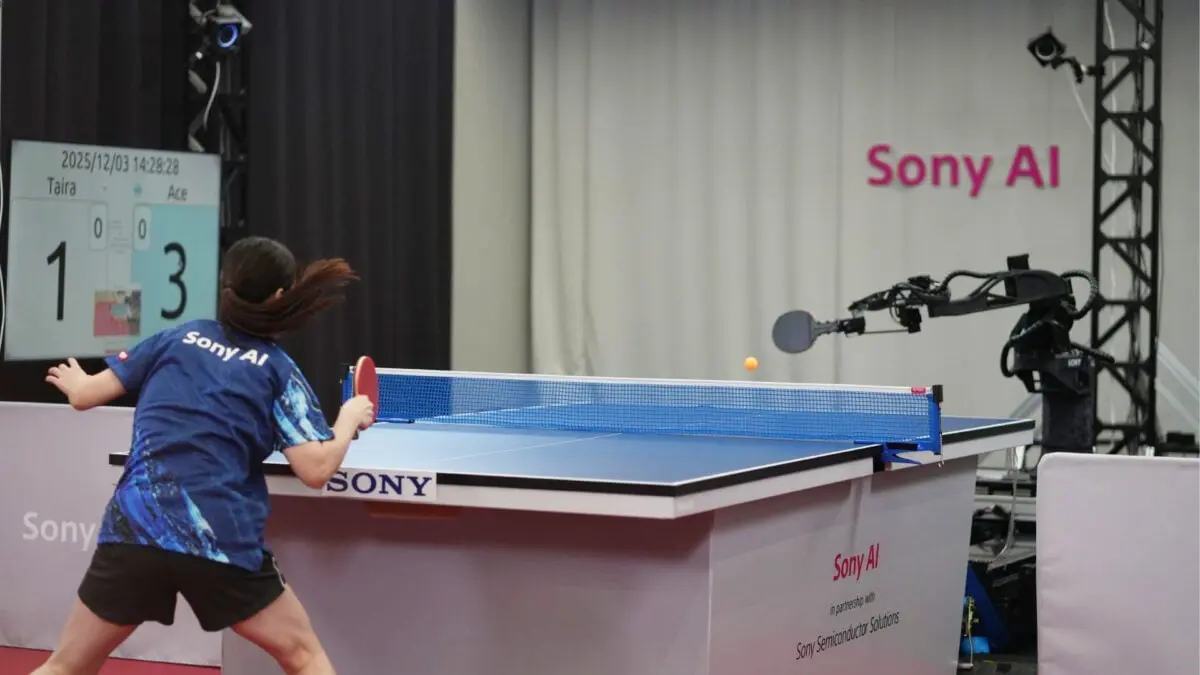
A new robotic contender has emerged in the world of table tennis, and it is not human. Sony's AI division has developed an autonomous robot named Ace, which can now compete with and even defeat elite human players. This achievement represents a significant leap forward in physical artificial intelligence, where robots must operate safely and effectively in the real world, combining perception, control, and agility in real time.
In a series of matches conducted between April 2025 and March 2026, Ace demonstrated remarkable progress. Initially, it won three out of five matches against elite players—defined as those with at least ten years of experience training twenty hours per week. However, it lost to professional players Minami Ando and Kakeru Sone, who compete in Japan's professional table tennis league. By December 2025, Ace had improved enough to beat both elite and professional players, winning one of two pro matches. In March 2026, the robot achieved a stunning victory over Miyuu Kihara, who was then ranked in the top 25 in the World Table Tennis women's singles rankings.
The matches were played under the official rules of the International Table Tennis Federation (ITTF), with licensed umpires overseeing the games. This rigorous approach sets Ace apart from earlier robot table tennis systems, which often used simplified conditions. The robot's ability to serve and return high-speed, high-spin balls consistently has been key to its success.
Ace's Development and Matches
The researchers at Sony AI designed Ace to study how artificial intelligence could operate in the physical world, where perfect information is not available. Unlike simulated environments, real-world table tennis demands rapid decision-making based on state estimation from noisy sensors and adversarial human interactions. The robot uses a combination of sensors, including high-speed cameras and force sensors, to track the ball and predict its trajectory. Its algorithms then plan and execute precise movements with millisecond timing.
During the matches, Ace displayed agile moves, quickly adjusting its position and racket angle to return difficult shots. The robot was able to generate spin by varying the angle and speed of its racket, making its returns challenging for human opponents. The study, published in the journal Nature, details the robot's performance and the underlying technology.
Technical Challenges
Building a table tennis robot has been a goal of researchers since the 1980s, but Ace represents a major step forward. One of the biggest challenges is the extreme speed of the ball, which can travel at over 100 kilometers per hour and spin at thousands of revolutions per minute. The robot must not only track the ball but also predict its trajectory after bouncing on the table, accounting for spin and surface friction. This requires sophisticated models of ball dynamics and real-time adaptation.
Ace's control system is based on a combination of model-based and learning-based approaches. The robot uses analytical models for trajectory prediction and a neural network for decision-making. It was trained using a combination of simulation and real-world data, allowing it to improve over time. The researchers also employed tactics such as aiming for the edges of the table to exploit weaknesses in human opponents' positioning.
Future Implications
While Ace is not expected to take over professional table tennis, the technologies developed for the project have broad applications. According to lead author Peter Dürr, the results may be used to create better robotic systems for sports, entertainment, and other safety-critical physical domains. For example, the same perception and control algorithms could be adapted for tasks like surgical assistance, manufacturing, or autonomous vehicles.
The project also raises questions about the future of human-robot interaction. As robots become more capable of complex physical tasks, they may be used as training partners for athletes or as assistants in hazardous environments. However, there are also challenges to overcome, including ensuring safety and reliability in unstructured environments. Ace's success shows that progress is being made toward these goals.
Beyond table tennis, the real-time decision-making and agility demonstrated by Ace could inspire new robotics applications in logistics, where robots need to sort and move objects quickly; in entertainment, where they could interact with human performers; and in healthcare, where they could assist with rehabilitation exercises. The lessons learned from Ace's development will likely influence future generations of robots that can operate alongside humans in dynamic settings.
Source: Gizmodo News