

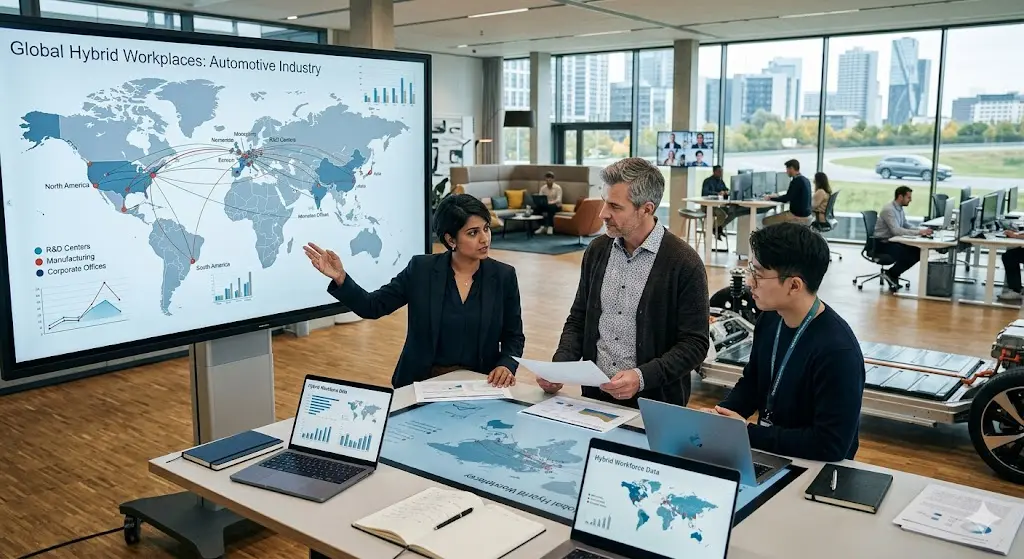
Global research on hybrid workplaces in the automotive industry shows that flexible work models are reshaping engineering, design, administration, supply chain management, and innovation processes. Automotive companies are increasingly combining remote and on-site work to improve productivity, attract specialized talent, reduce costs, and support employee satisfaction while maintaining operational efficiency.
Global research on hybrid workplaces in the automotive industry reveals a major transformation in how vehicle manufacturers, suppliers, technology providers, and mobility companies operate. While manufacturing lines still require physical presence, many automotive functions can now be performed remotely or through hybrid arrangements.
Here's the thing: the automotive sector has traditionally been associated with factories, testing facilities, and engineering centers. Yet digital technologies, cloud collaboration tools, and advanced communication platforms have created new opportunities for workplace flexibility. As organizations compete for highly skilled talent and seek operational improvements, hybrid workplace strategies are becoming an important part of long-term business planning.
What Is Global Research on Hybrid Workplaces in the Automotive Industry?
Hybrid Workplace in the Automotive Industry: A work model that combines remote and on-site work arrangements, allowing employees to perform specific responsibilities from different locations while maintaining collaboration, productivity, and operational effectiveness.
Global research on hybrid workplaces in the automotive industry examines how flexible work models affect workforce performance, innovation, employee engagement, recruitment, operational efficiency, and organizational culture.
Research commonly focuses on:
Automotive workforce trends
Remote engineering collaboration
Hybrid leadership models
Digital workplace technologies
Talent acquisition strategies
Employee retention
Productivity measurement
Organizational transformation
Unlike fully remote organizations, hybrid automotive workplaces balance digital flexibility with the practical requirements of manufacturing, testing, and production activities.
Expert Tip
In my experience, successful hybrid strategies begin with role analysis rather than workplace policies. Companies that understand which tasks truly require physical presence often achieve better outcomes.
Why Hybrid Workplaces Matter in 2026
The automotive industry continues to evolve rapidly through electrification, automation, software development, and connected vehicle technologies.
Hybrid workplaces are becoming increasingly important because they support these changes while helping companies remain competitive.
Talent Competition Is Intensifying
Automotive organizations compete with technology companies for engineers, software developers, cybersecurity specialists, and data analysts.
Flexible work arrangements often help attract highly qualified candidates who value location independence.
Digital Transformation Is Accelerating
Modern vehicles contain sophisticated software systems, connected technologies, and digital services.
Many of the professionals responsible for developing these solutions can perform significant portions of their work remotely.
Employee Expectations Continue to Shift
Workplace preferences have changed considerably.
Many professionals now expect flexibility as part of their employment experience. Organizations that ignore these expectations may face recruitment and retention challenges.
Cost Optimization Opportunities
Hybrid models can reduce office space requirements and facility expenses.
Savings may then be redirected toward research, innovation, employee development, and technology investments.
Global Collaboration Is Expanding
Automotive projects frequently involve teams located across multiple regions.
Hybrid work environments support international collaboration without requiring constant travel.
Expert Tip
Organizations often focus heavily on workplace flexibility but underestimate the importance of management training. Hybrid success depends just as much on leadership practices as technology investments.
How to Build an Effective Hybrid Workplace in the Automotive Industry
Creating a successful hybrid environment requires careful planning and execution.
1: Identify Hybrid-Compatible Roles
Not every automotive position can operate remotely.
Companies should evaluate which responsibilities can be completed effectively outside traditional office settings.
Examples include:
Software development
Data analysis
Marketing operations
Financial management
Human resources
Customer support functions
Clear role categorization reduces confusion.
2: Invest in Digital Collaboration Tools
Technology forms the foundation of hybrid workplaces.
Teams need reliable communication platforms, project management systems, document-sharing solutions, and cybersecurity protections.
Without proper infrastructure, productivity can suffer quickly.
3: Create Structured Communication Processes
Remote and hybrid teams require intentional communication.
Organizations should establish:
Regular team meetings
Project update schedules
Performance review processes
Knowledge-sharing systems
Collaboration guidelines
Consistency helps maintain alignment across distributed teams.
4: Measure Outcomes Instead of Activity
One common mistake involves monitoring employee activity rather than performance.
Effective hybrid workplaces emphasize results, project completion, innovation contributions, and customer outcomes.
5: Strengthen Company Culture
Culture doesn't disappear in hybrid environments.
It simply requires more deliberate effort.
Virtual engagement programs, mentorship opportunities, leadership visibility, and recognition initiatives help maintain organizational cohesion.
6: Continuously Refine Workplace Policies
Hybrid work models evolve over time.
Regular feedback collection and performance reviews help organizations identify opportunities for improvement.
Common Mistake or Misconception
Hybrid Work Automatically Improves Productivity
Many leaders assume flexibility alone will generate better performance.
Reality is more complicated.
Productivity improvements occur when organizations combine flexibility with accountability, communication, and effective management systems.
A surprising finding from many workplace studies is that poorly managed hybrid teams may struggle more than traditional office teams.
What most people overlook is that flexibility amplifies existing management strengths and weaknesses. Strong leaders often achieve excellent results, while weak management practices become even more visible.
I've seen organizations implement expensive workplace technologies while neglecting leadership development. Predictably, performance gains remained limited.
Why Automotive Engineering Teams Are Adopting Hybrid Models
Engineering functions represent one of the most significant areas of workplace transformation.
Many design and development activities can now occur through digital collaboration environments.
Virtual Product Development
Advanced software allows engineers to collaborate on vehicle systems from multiple locations.
Digital simulations reduce the need for constant physical testing during early development stages.
Faster Access to Specialized Expertise
Hybrid work enables companies to recruit experts regardless of geographic location.
This broader talent pool can accelerate innovation and problem-solving.
Improved Project Flexibility
Engineering teams often work across time zones.
Hybrid environments support asynchronous collaboration and more efficient project coordination.
Reduced Travel Requirements
Digital collaboration tools reduce the need for frequent in-person meetings.
Organizations can allocate resources toward higher-value activities instead.
Expert Tip
Engineering leaders should prioritize documentation. Hybrid environments depend heavily on clear knowledge sharing and project transparency.
How Hybrid Work Is Affecting Automotive Manufacturing Support Functions
Production lines require physical operations, but many supporting departments have embraced flexibility.
Supply Chain Management
Supply chain professionals increasingly use cloud-based systems to monitor inventory, logistics, and supplier performance remotely.
Procurement Operations
Purchasing teams can coordinate supplier relationships and contract negotiations through digital platforms.
Quality Assurance Analytics
Data-driven quality management often relies on remote monitoring tools and centralized reporting systems.
Customer Experience Teams
Customer support, warranty services, and digital engagement teams frequently operate through hybrid structures.
This flexibility can improve responsiveness while reducing operational expenses.
The Impact on Recruitment and Employee Retention
Hybrid work has become a significant factor in workforce planning.
Expanded Candidate Pools
Organizations can recruit talent from broader geographic areas.
This approach often increases access to specialized expertise.
Improved Employee Satisfaction
Flexible work arrangements may support better work-life balance.
Many employees value the ability to manage professional and personal responsibilities more effectively.
Reduced Turnover
Companies offering workplace flexibility frequently experience stronger retention outcomes.
Replacing experienced professionals can be expensive, making retention a strategic priority.
Employer Brand Enhancement
Organizations known for flexible workplace policies often attract higher levels of candidate interest.
In competitive labor markets, reputation matters.
Expert Tips and What Actually Works
After examining workplace transformation trends across multiple industries, several best practices consistently emerge.
Focus on Trust
Hybrid workplaces function best when managers trust employees to deliver results.
Excessive monitoring can reduce engagement and morale.
Prioritize Communication Skills
Technical expertise matters.
Communication skills matter just as much.
Distributed teams rely heavily on clear information sharing.
Establish Clear Expectations
Ambiguity creates frustration.
Employees perform better when responsibilities, goals, and success metrics are clearly defined.
Use Technology Thoughtfully
Technology should simplify work, not complicate it.
Too many tools can create confusion and inefficiency.
My Personal Take
One of the biggest misconceptions about hybrid workplaces is that they're primarily about employee convenience. From what I've seen, the strongest business case often revolves around access to talent. Companies that can recruit exceptional professionals regardless of location gain a meaningful competitive advantage.
Real-World Example
Imagine a global automotive supplier struggling to hire software engineers within commuting distance of its headquarters.
After implementing a hybrid workplace strategy, the company expands recruitment nationally and internationally. Within eighteen months, development timelines improve, vacancy periods decline, and employee retention strengthens.
While hypothetical, this example reflects trends observed across many technology-driven automotive organizations.
Expert Tip
Hybrid workplace policies should be flexible enough to evolve. What works for a 500-person company may not work for a multinational enterprise employing tens of thousands of people.
People Most Asked About Hybrid Workplaces in the Automotive Industry
What is a hybrid workplace in the automotive industry?
A hybrid workplace combines remote and on-site work arrangements, allowing employees to perform certain responsibilities from different locations while maintaining collaboration and productivity.
Which automotive roles are most suitable for hybrid work?
Software development, engineering design, marketing, finance, human resources, customer support, and data analytics positions are often well suited for hybrid models.
Does hybrid work improve employee retention?
Many organizations report improved retention because employees value flexibility and greater control over their work environments.
How does hybrid work affect innovation?
When managed effectively, hybrid environments can support innovation by expanding access to diverse talent and encouraging broader collaboration across geographic regions.
What challenges do hybrid automotive workplaces face?
Common challenges include communication gaps, maintaining company culture, cybersecurity concerns, performance measurement, and leadership adaptation.
Can manufacturing employees participate in hybrid work?
Production-line responsibilities generally require physical presence. However, many support functions associated with manufacturing can operate through hybrid arrangements.
Why is hybrid work becoming more common in automotive companies?
Competition for skilled talent, digital transformation initiatives, operational efficiency goals, and changing employee expectations are driving adoption.
Will hybrid workplaces remain important in the future?
Most research suggests hybrid models will continue playing a significant role, particularly for knowledge-based and technology-focused automotive functions.
Final Thoughts
Global research on hybrid workplaces in the automotive industry demonstrates that workplace flexibility is becoming an important component of organizational strategy. While manufacturing operations continue to require physical presence, many engineering, administrative, and technology-focused functions can benefit from hybrid arrangements.
Companies that combine effective leadership, strong communication systems, thoughtful technology investments, and clear performance expectations are likely to gain the greatest advantages. As automotive innovation accelerates, hybrid workplaces may become one of the key factors supporting talent acquisition, operational efficiency, and long-term competitiveness.
Businesses, agencies, startups, bloggers, and SEO professionals can strengthen brand visibility through online press release distribution combined with strategic digital marketing agency solutions. Generate high authority backlinks, improve SEO ranking, increase organic traffic, secure wider media coverage, and benefit from instant publishing opportunities that help your business achieve stronger online growth and authority.