

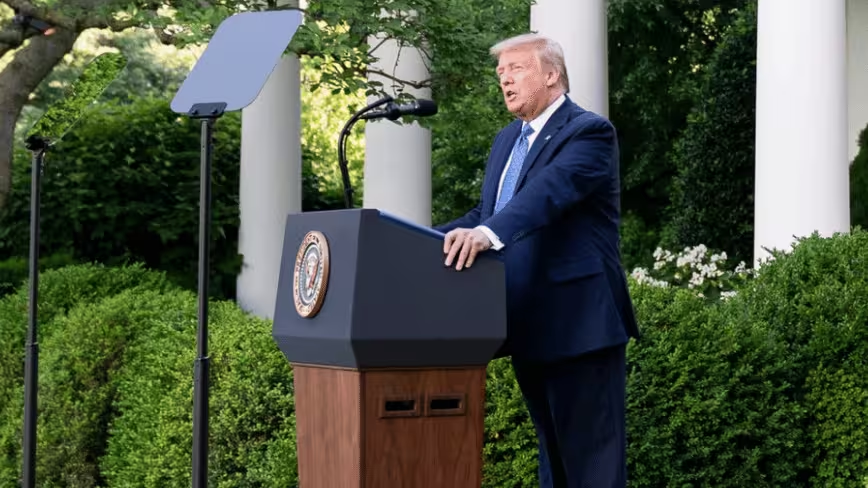
President Donald Trump told reporters on Air Force One on Friday that he and Chinese President Xi Jinping discussed AI guardrails and Nvidia's H200 chips during their two-day summit in Beijing. Speaking to the press as he departed, Trump described the talks as covering 'standard guardrails that we talk about all the time,' though he provided no specific details on what those guardrails would entail.
The summit concluded without a signed AI governance framework, marking a notable gap in what many observers had hoped would be a breakthrough in US-China technology relations. Just before the meeting on Thursday, the United States had cleared roughly ten Chinese technology firms—including Alibaba, Tencent, ByteDance, JD.com, and Lenovo—to buy up to 75,000 H200 chips each under a new export-licensing regime. However, not a single H200 chip has yet been shipped to those cleared buyers. The phrase 'standard guardrails' has drawn scrutiny because the US and Chinese governments have not, on the record, agreed on what those guardrails would actually cover.
The two leaders also addressed Nvidia's H200 chips, which are a generation behind the Blackwell line still subject to export controls. The US administration's reasoning, publicly framed by Nvidia CEO Jensen Huang last week, is that selling regulated Chinese demand to Nvidia keeps the revenue and US jobs in-country. However, the export-licensing regime is unusually elaborate: China-bound H200 volumes are capped at no more than 50% of Nvidia's US domestic sales, each shipment must be verified by a US-headquartered third-party laboratory, Chinese buyers must certify against military use, and the deal includes a 25% revenue share routing through US territory. So far, these conditions have resulted in paper clearance rather than physical delivery.
Time magazine's account of the meeting described AI as 'the elephant in the room' rather than the centerpiece, with the public-facing conversation focused on trade and the H200 question while a deeper bilateral framework on autonomous weapons, model misuse, and dual-use AI was discussed only in outline. Senior officials briefing on background suggested that the two governments are considering a recurring dialogue track on AI risk, but no schedule, working group, or signed text has emerged from this round.
The political response in Washington was swift. Senate Democratic leader Chuck Schumer posted that 'giving China access to this premier US technology is dangerous and threatens our lead in the AI race.' This sentiment underscores the deep partisan and strategic divide over technology transfer to China. Meanwhile, China's rare-earth controls, imposed last year to retaliate against earlier US tariffs, are still constraining Western magnet and motor supply chains and were not lifted as part of the AI conversation. Rare earths and chips sit in the same negotiating folder on both governments' read-outs, but they did not move together in Beijing.
The corporate stakes are visible in the broader AI capex cycle. Hyperscalers have committed more than $650 billion to AI infrastructure across 2026, based on the combined Q1 numbers from Microsoft, Alphabet, Amazon, Meta, and Apple. Nvidia sits at the center of the supply side of that spend. A China revenue line, even at controlled volumes and with a 25% pass-through, materially changes its medium-term forecast. Microsoft and OpenAI's joint trajectory is the visible US half of that picture; Huawei's Ascend chips are the half the export regime is implicitly trying to slow down.
The background to these discussions is a long history of US-China technology tensions. The US has imposed various export controls on advanced semiconductors and manufacturing equipment to prevent China from using US technology to modernize its military. China, in turn, has restricted exports of rare earth elements, which are critical for many high-tech products. The H200 chip is a specific point of contention because it is powerful enough for AI training but not the most advanced chip available. By allowing sales of the H200 while blocking the Blackwell series, the US aims to maintain a technological edge while still supporting US industry.
The concept of AI guardrails refers to frameworks for governing AI development and use, including safety standards, transparency requirements, and bans on autonomous weapons. While both countries have expressed interest in such guardrails, their approaches differ significantly. The US emphasizes voluntary guidelines and industry self-regulation, while China advocates for stronger government control and alignment with its social values. Without a signed agreement, the two sides remain far apart on what these guardrails would look like.
The stalled deliveries of the H200 chips also highlight the gap between policy announcements and actual implementation. The ten cleared Chinese buyers had hoped to receive the chips soon after the summit, but logistical and political hurdles remain. The requirement for third-party verification and the 25% revenue share are designed to ensure compliance, but they also slow down the process. Chinese firms are likely to seek alternative sources, including Huawei's Ascend chips, which are not subject to US export controls but are less advanced.
Looking ahead, the lack of a signed agreement on AI guardrails means that future discussions will be crucial. The two sides may establish a working group to continue talks, but the political climate in both countries makes it difficult to achieve a binding framework. For now, the H200 chip sales remain a test case for whether the US export regime can balance economic interests with national security concerns.
The rare-earth question also remains unresolved. China controls most of the world's rare earth production, and its export restrictions have caused price increases and supply chain disruptions for Western manufacturers. The US and its allies are trying to diversify their sources, but progress is slow. Until a broader trade deal is reached, rare earths and chips will likely continue to be linked in negotiations.
In the context of the broader AI race, the Beijing summit was a missed opportunity for substantive progress. The two largest AI powers have much to gain from cooperation on safety standards and risk mitigation, but their strategic competition is now deeply ingrained. Trump's read-out from Air Force One is, in that frame, less a substantive AI-policy announcement than a procedural signal. The president confirmed that AI guardrails and H200s were on the agenda and that the licensing regime cleared earlier in the week remains operative on the chip side. But the signed text everyone was watching for did not arrive.
The implications for Nvidia are significant. The company's future revenue depends heavily on sales to China, but the export controls limit how much it can sell. Jensen Huang's argument that selling the H200 chips keeps US jobs competitive is countered by critics who say it still gives China access to advanced technology. The debate will continue as the US reviews its export policies and as China develops its own semiconductor industry.
Ultimately, the summit underscored the complex interplay of technology, economics, and geopolitics. Without a clear agreement on AI guardrails or chip sales, the US-China relationship remains fraught with uncertainty. The next steps will likely involve lower-level talks and incremental moves, but the underlying tensions will persist.