

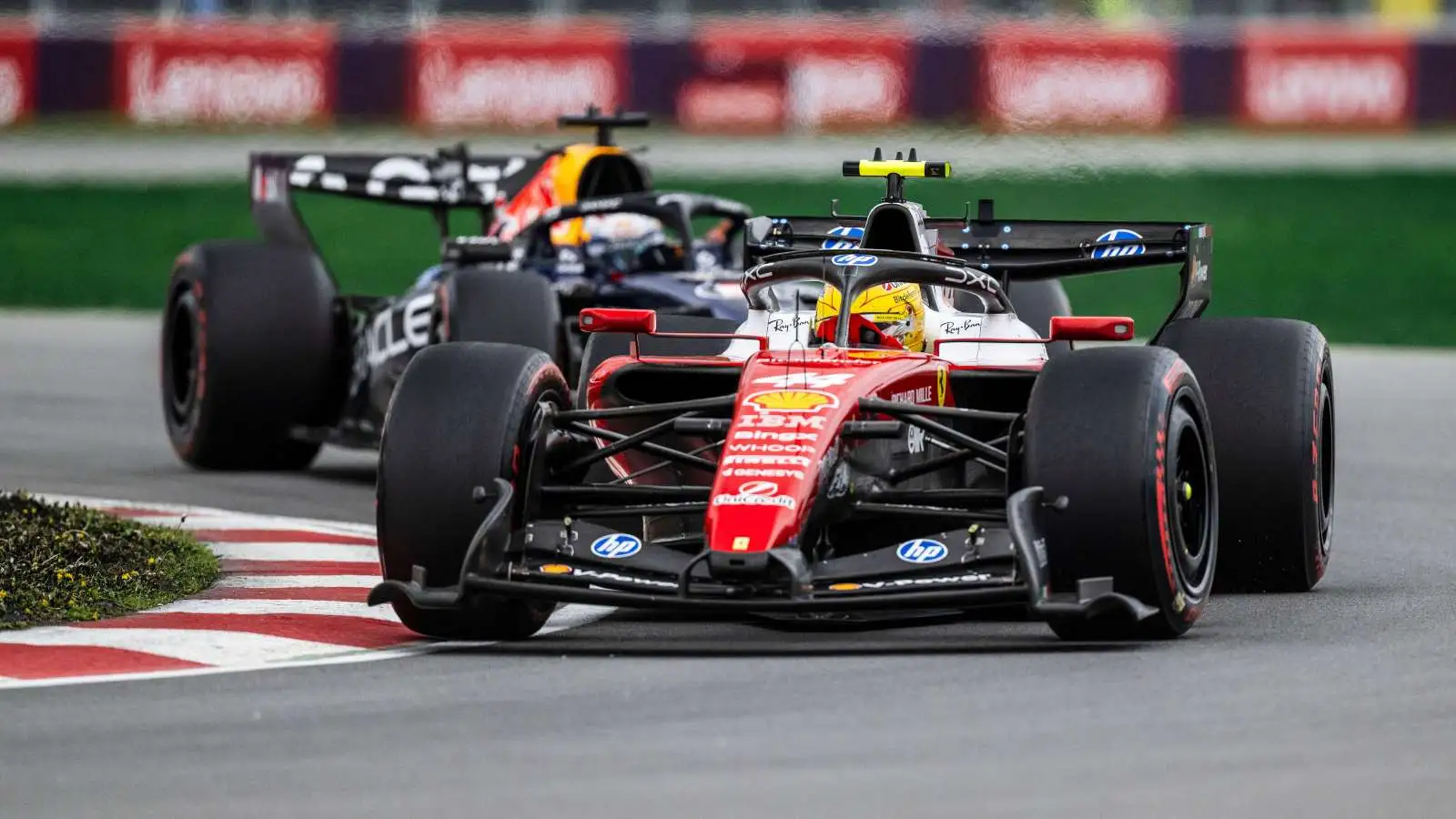
Arguably his best race weekend since arriving at Ferrari, Lewis Hamilton delivered a stellar performance in Canada – a track where he has already taken victory seven times in his career. The seven-time world champion showcased his mastery of the Circuit Gilles Villeneuve, a track that demands precision, bravery, and strategic thinking. From the opening laps, Hamilton was in the zone, pushing his SF-25 to its limits and engaging in a thrilling battle with his old rival Max Verstappen.
To make things even sweeter, he clinched the battle for second place against none other than Max Verstappen. With the help of telemetry data, we uncover new details that provide a different perspective on this Hamilton battle. The data reveals not only the tactical genius behind the move but also the immense physical and mental effort required to execute such a pass at high speed.
Lewis Hamilton reels in Max Verstappen for thrilling Canadian GP battle
As we have already mentioned, the seven-time world champion was very much in the mood for racing throughout the entire weekend in Canada. From Friday practice, Hamilton looked comfortable with the car's balance, particularly in the low-speed sections where Ferrari has struggled in previous races. His confidence grew through qualifying, where he narrowly missed pole position but still lined up third on the grid, behind the McLaren duo.
Although he fell just short of putting together the perfect lap in qualifying to secure a starting position ahead of the McLaren drivers, a positive mood and optimism for the race were clearly visible in the British driver. Hamilton's body language in the pre-race interviews suggested a man who believed in his chances, despite the raw pace disadvantage of the Ferrari power unit on the long straights.
In the end, it turned out that McLaren quite literally gifted him a position ahead of them by choosing intermediate tyres for the race start. With rain expected but not yet falling, McLaren's gamble backfired, forcing both Lando Norris and Oscar Piastri to pit after just a few laps. Hamilton, who had started on soft slicks like Verstappen, avoided that trap and gained track position.
After overtaking Piastri into Turn 1 and with Norris subsequently pitting for tyres, Hamilton found himself in third place, holding a very strong position for a podium finish, with his old rival Max Verstappen standing in his way. The battle that ensued would become one of the defining moments of the 2026 season, showcasing the veteran's relentless pursuit of excellence.
Verstappen and Red Bull were faster than expected at the beginning of the race. It appears they found a very strong pace on the soft tyres, which was later not the case on the mediums. The Red Bull RB22 seemed to have a narrow operating window, and once the track temperature dropped, Verstappen struggled to extract the same performance. He quickly got within one second of Hamilton and, on Lap 9 of the race, made his move by overtaking him down the inside into T1.
We could hear Hamilton on the radio asking his engineers for power, and if we look at the telemetry data, we can see the background to this request. The Ferrari's hybrid system was being depleted as Hamilton tried to fend off Verstappen's DRS-assisted attack. Specifically, ever since Max entered the danger zone, Lewis began increasing his electrical energy deployment on the straight from the hairpin to T13, keeping in mind that this was exactly where he was most vulnerable. The price he paid for this was a lower top speed on the start-finish straight because his hybrid battery was depleted.
Verstappen capitalised on this on Lap 8 of the race, preparing his attack and securing a significant enough speed delta on the start-finish straight to comfortably move up into P3. It was a textbook DRS pass, but Hamilton knew he would get another chance later in the race when tire degradation and track evolution would shift the balance.
Over the next few laps, Hamilton remained within a second of Max but without an opportunity to overtake, until Lap 22 when he made a major mistake. A front-right wheel lock-up entering T8 forced him off the track, losing almost four seconds as a result. This error could have cost him any chance of a podium, but the race was far from over. In the graph below, you can see the exact moment that dropped Hamilton out of the immediate podium fight.
The Virtual Safety Car deployed due to the failure on Russell’s car was used by all the front-runners to change tyres, setting up a new round of this battle. The timing of the VSC was perfect for Hamilton, allowing him to pit without losing significant time to Verstappen. It also reset the tire age, giving both drivers a fresh set of medium compound tyres for the final stint.
At the beginning of this stint on the medium, Verstappen struggled to warm up his tyres on the cold track surface, which opened the window perfectly for Hamilton. Over the next few laps, Lewis was consistently faster, and by Lap 45, he had the opportunity to use his overtake mode. The graph below neatly illustrates how the British driver did a better job of warming up his tyres and finding the optimal rhythm.
The areas where Lewis closed the gap the most were precisely the traction zones: the Turn 8-9 chicane as well as the hairpin. The hairpin, in particular, is a critical corner for overtaking, as a good exit can propel a car past a rival on the following straight. Hamilton's superior traction out of the hairpin allowed him to get within DRS range lap after lap.
Throughout the entire weekend, Hamilton was exceptional in these sections where, due to track conditions, you have very little rear-axle grip when getting on the throttle. In fact, these sections presented the biggest challenges for the drivers, including his teammate, who ultimately failed to find a solution to this issue. Charles Leclerc, usually strong on such tracks, struggled with oversteer and could not match Hamilton's pace in the final stint.
Taught by his experience from the beginning of the race, analysing the telemetry data suggests that Lewis knew exactly how he was going to execute his attack on Max. The British driver learned from his earlier failure in Lap 9 and devised a new strategy. He would sacrifice his exit from the final chicane to save battery energy, then unleash a massive electrical boost on the start-finish straight. A lap before the attack, Lewis increased his harvesting on the start-finish straight to recharge his battery. In addition to this, he altered his approach through the final chicane (now being significantly slower and earlier on the brakes compared to previous laps), after which he delivered all the electrical power available to him, overtaking Verstappen down the outside of the start-finish straight.
Despite carrying much higher speed, he managed to maintain control of the car under braking and secure second position in the grand prix. Note the speed on the start-finish straight during the attack (shown in yellow) compared to earlier laps – a truly massive difference. Hamilton's braking point was perfectly judged; he braked later than Verstappen but still made the corner without locking up. It was a move reminiscent of his prime Mercedes years.
Although Verstappen remained within one second even after that, there was no real opportunity for a counter-attack. Excellent driving from Hamilton and a well-deserved podium finish. The Dutchman tried to use DRS on the following laps, but Hamilton's tire management and race craft kept him ahead. In the final laps, Hamilton even pulled away slightly, demonstrating that Ferrari's race pace was superior to Red Bull's on the medium tyre.
The fact is that Hamilton would have had a significantly harder time reaching this position had it not been for Russell’s retirement and the tyre strategy error on the McLaren cars, but Ferrari certainly has a reason for optimism. Being competitive on a track where engine power is more critical than at other venues is a good sign for the Maranello-based team. The Canadian Grand Prix has historically been a power-sensitive circuit, and Ferrari's ability to challenge for the podium with a slightly weaker engine is a testament to their chassis and aerodynamic efficiency.
Ferrari has done a brilliant job with the car’s aerodynamics and chassis; the hope remains that it will manage to catch up with the competition in terms of power unit development to be consistently fighting for the top spot once again. The team's technical director has already announced several upgrades for the next round in Spain, which could further close the gap to Red Bull and McLaren. For Hamilton, this race was a reminder that his race craft remains among the best in the sport. Despite being 41 years old, he can still outfox younger rivals like Verstappen when the conditions allow. The Canadian GP was not a victory, but it was a statement of intent from both driver and team.
Source: PlanetF1 News