

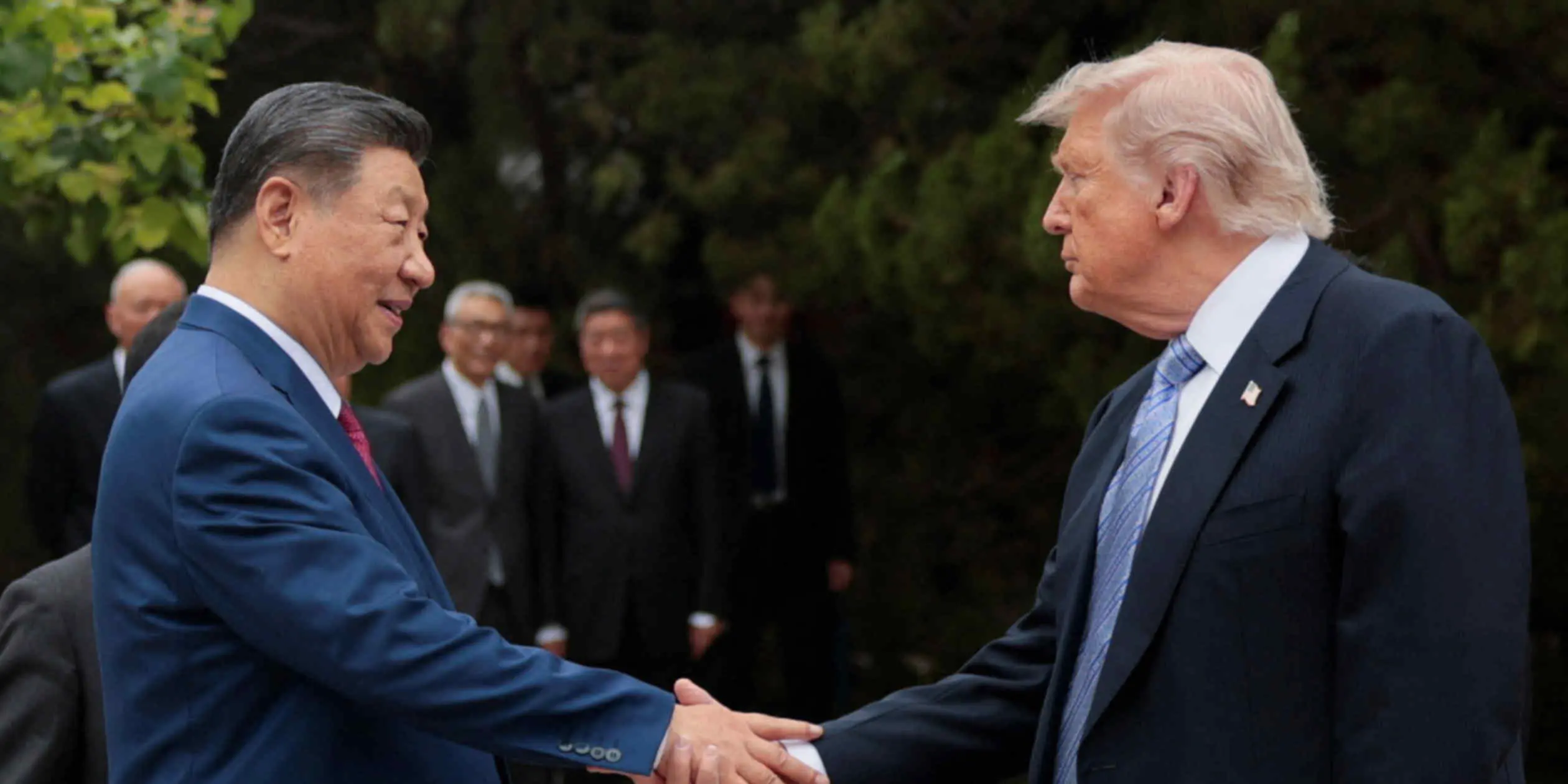
U.S. President Donald Trump is wrapping up his first visit to China in nearly nine years, as the rival superpowers aim to stabilize their fraught relationship. The American president arrived Wednesday evening and is scheduled to stay until Friday, with an itinerary packed with face time with Chinese President Xi Jinping, from formal bilateral talks to a state banquet, tea and lunch.
The leaders have much to discuss: the Iran war, trade and export controls, tensions over Taiwan, and artificial intelligence. Trump brought an entourage of corporate executives including Tesla's Elon Musk, Apple's Tim Cook and Nvidia's Jensen Huang. There are high expectations that the president will help seal commercial deals for aircraft and U.S. farm goods.
On Friday, live news footage showed a crowd building at the airport near Air Force One, ahead of Trump's departure from China. Students dressed in blue and white — similar to the colors of Trump's plane — were there to see him off. Trump said "a lot of good" has come out of his trip, and that they have made "fantastic trade deals," the details of which remain unknown. In their second day of meetings, Xi echoed China's framing of U.S. ties as a "constructive relationship of strategic stability."
Coinciding with the summit, Anthropic urged the U.S. and its allies to not let the Communist Party of China take the lead in the AI race, saying strict chip export controls are needed to keep democracies ahead of "authoritarian governments." News photos from the morning showed crowds of onlookers gathering to catch a glimpse of Trump's motorcade and snap photos.
Trump and Xi met again at Zhongnanhai, the headquarters of the Communist Party leadership in Beijing. China's foreign ministry said they reached "a series of new consensuses," committing on "properly handling each other's concerns and agreed to strengthen communication and coordination on international and regional issues." On the Iran war, China stated: "Shipping routes should be reopened as soon as possible, responding to the calls of the international community, and jointly maintaining the stability and smooth flow of global supply chains." They also called for "a comprehensive and lasting ceasefire... to promote the early restoration of peace and stability in the Middle East and the Gulf region."
Trump was scheduled to take a "friendship photo" with Xi later that morning, before the leaders sat down for tea and lunch, aiming to firm up concrete "deliverables" from the visit before the American president departed in the afternoon. Secretary of State Marco Rubio said the U.S. hopes for a "positive response" from China on the case of Jimmy Lai, the imprisoned 78-year-old Hong Kong media tycoon. "The president always raises that case and a couple others, and obviously we'll hope to get a positive response from that," Rubio told NBC News. "We'd be open to any arrangement that would work for them, as long as he's given his freedom."
Lai was convicted last year of colluding with foreign forces and publishing seditious materials through his now-defunct newspaper, Apple Daily. He denied the charges, and earlier this year was given a 20-year jail sentence, widely considered a life term considering his ailing health. Before the summit, Trump said that Lai "caused lots of turmoil for China," but added, "He tried to do the right thing. He wasn't successful, went to jail, and people would like him out, and I'd like to see him get out too."
Trump also posted on Truth Social that he "fully agrees" with Xi that the U.S. used to be a fading nation, blaming that view on his predecessor, Joe Biden. "When President Xi very elegantly referred to the United States as perhaps being a declining nation, he was referring to the tremendous damage we suffered during the four years of Sleepy Joe Biden and the Biden Administration, and on that score, he was 100% correct," Trump wrote. He added, "President Xi was not referring to the incredible rise that the United States has displayed to the world during the 16 spectacular months of the Trump Administration," pointing to factors such as record-high stocks and the "military decimation of Iran (to be continued!)."
Boeing's shares dropped more than 4% in U.S. trading on Thursday, after Trump told Fox News that China would be buying 200 aircraft — a smaller order than expected. The plane maker's CEO, Kelly Ortberg, is part of the U.S. delegation to China. Xi gave his assurance that China will not provide weapons to Iran, Trump said. "President Xi would like to see a deal made," Trump told Fox News host Sean Hannity. "He would like to see a deal made. And he did offer, he said 'if I can be of any help at all, I would like to be of help.'" Xi also pledged cooperation on opening the Strait of Hormuz, according to Trump. There was no immediate comment from the Chinese side.
On Thursday, shares in Nvidia were up 4% in New York trading after a Reuters report that the U.S. had approved sales of the powerful H200 chip to Chinese companies. Nvidia CEO Jensen Huang joined the entourage of American business leaders accompanying Trump to China. The H200 is a high-end AI processor that is more advanced than the H20 chips Nvidia designed for the Chinese market in response to U.S. export restrictions. Asked this month whether China should have the "latest and greatest chips," Huang replied, "No," adding the U.S. should maintain a lead in artificial intelligence.
A U.S. State Department photo showed the American delegation in Beijing, including top business leaders. Tesla CEO Elon Musk, Apple's Tim Cook and Citigroup's Jane Fraser can be seen standing behind Trump. Russia says it will be conducting its own diplomacy with China's president. "We are expecting our own separate contacts with Xi Jinping," Kremlin spokesman Dmitry Peskov said when asked if Beijing and Moscow would consult about the outcome of Trump's visit, according to Reuters. Russian President Vladimir Putin is expected to visit China soon.
In an taped interview with CNBC, Treasury Secretary Scott Bessent offered tidbits about Chinese investment, AI, and commercial deals. On discussions about setting up a board of investment with Beijing, the purpose would be "to decide up front, what are the non-strategic, non-sensitive areas where it would be possible for the Chinese to invest." Regarding AI, he said the two sides will be discussing "guardrails." "The Chinese are substantially behind us, but they have a very advanced AI industry here. So the two AI superpowers are going to start talking. We're going to set up a protocol in terms of, how do we go forward with best practices for AI to make sure non-state actors don't get ahold of these models." Bessent said he expects to see "large" Boeing orders. And on Taiwan, he offered assurance that Trump "understands the issues here and understands the sensitivities around all of this."
While Trump and Xi were talking and toasting in Beijing, China continued to apply military pressure across Asia, according to a senior official in the region who spoke to Nikkei Asia on condition of anonymity. The official said there were close to 90 Chinese defense and coast guard vessels detected from the East China Sea and the Taiwan Strait to the South China Sea, describing this as a typical day of "gray zone" activity. "Beijing's strategy is to push the narrative that 'we are for peace, we are not the troublemakers' during the summit, while continuing to flex its military muscles. Chinese air and maritime harassment against Taiwan has not stopped because of Trump's visit," the official said. Taiwan's Ministry of National Defense said in its daily update that it had spotted three sorties by Chinese military aircraft and six Chinese naval vessels in the 24 hours up to 6 a.m. Thursday. Xi issued an explicit warning to Trump about Taiwan in their morning meeting.
In a banquet speech, Xi said that China's population of 1.4 billion draws on the heritage of 5,000 years of civilization, while 300 million Americans are marking the country's 250th anniversary this year. He referred to them both as "great peoples." "The great rejuvenation of the Chinese nation and making America great again can go hand in hand," Xi said. Trump spoke next and said he is inviting Xi and his wife to visit the White House on Sept. 24. "The American and Chinese people share much in common," Trump said. "We value hard work. We value courage and achievement, we love our families and we love our countries. Together we have the chance to draw these values to create a future of greater prosperity, cooperation and happiness and peace for our children."
Chinese Premier Li Qiang met business leaders, including Nvidia CEO Jensen Huang, Tesla CEO Elon Musk and Apple CEO Tim Cook, on Thursday afternoon. Footage of the meeting showed BlackRock CEO Larry Fink and Meta President Dina Powell McCormick also in attendance. "I see many familiar faces and old friends," Li said in televised opening remarks. He stressed that "China and the U.S. can and should continue to be friends and partners." There have been no surprises from the summit so far, Taiwan's Mainland Affairs Council said, according to Reuters. It says Taipei remains in close contact with Washington.
As Nvidia CEO Jensen Huang's attendance in the bilateral meeting fueled speculation over whether Washington will ease export curbs over its AI chips, China's commerce ministry noted the country's role in the AI supply chain. "China is a key supplier of global AI infrastructure," a ministry spokesperson said during a regular briefing, adding that it is both "a major buyer and seller" of semiconductors. For the first four months of the year, China's chip exports grew 83.7% year-on-year in dollar terms and 10.6% by volume, according to customs data. Regarding the outcomes of the U.S.-China trade talks, the spokesperson only commented that China is willing to "expand the list of cooperation opportunities and reduce the list of problems."
After their meeting, Trump and Xi headed for a tour of the Temple of Heaven, a World Heritage site once used by emperors to pray for good harvests. As they posed for photos, someone called out a question to Trump about whether he talked about Taiwan. The president did not respond. The initial bilateral meeting concluded after about two hours. Chinese media reported that several members of Trump's business delegation, including Tesla's Elon Musk, Apple's Tim Cook and Nvidia's Jensen Huang, entered the meeting room. Xi warned Trump that handling the issue of Taiwan "poorly" risks a "clash" between the powers, according to Chinese state media. He also said that "Taiwan independence" and peace across the Taiwan Strait are incompatible. It was not immediately clear what Trump said on the matter. Ahead of the summit, observers were focused on whether Trump might shift the typical U.S. language on Taiwan, such as by saying that Washington "opposes" Taiwan independence rather than just "not supporting" it. Doing so would be seen as a win for Beijing. From the U.S. perspective, "not supporting independence" refers to a move by Taipei to declare de jure independence as a Taiwanese republic and abolish the old constitutional order. Beijing, however, views anyone who opposes its claim to sovereignty over Taiwan, or even supports the status quo, as advocating "Taiwan independence." The leaders are understood to have sidestepped the Taiwan question at their last meeting in South Korea in October.
With Boeing CEO Kelly Ortberg traveling with Trump, a key focus was whether China would agree to purchase the company's aircraft. China is looking to buy as many as 600 jetliners, according to media reports. That is twice as many as the 300 planes that state-owned China Aviation Suppliers Holding Company agreed to purchase during Trump's previous visit in 2017, which Boeing said were worth $37 billion based on catalog prices. Boeing has been hit by U.S.-China trade tensions, opening an opportunity for French rival Airbus to gain ground in China. Over the past two months, state-owned China Southern Airlines and China Eastern Airlines have announced deals to buy 238 Airbus planes worth a combined $37.2 billion at catalog prices. Analysts will be watching for the timing of deliveries. China's travel industry is growing but airlines are facing mounting pressure from the country's expansive high-speed rail network, which generally offers lower ticket prices. The Iran war is further casting a shadow on consumer demand. Starting Saturday fuel surcharges for domestic flight tickets are set to rise by up to 50 yuan ($7.40).
As the meeting began, Xi and Trump delivered opening remarks. Xi asked whether the U.S. and China can establish a new paradigm of great power relations, address global issues and stabilize a rapidly changing world. "These are questions of history, questions of the world, and questions of the people," Xi said. "They are also the answers that you and I, as leaders of major powers, must jointly write for our times." Warning that cooperation helps both countries while confrontation harms both, he said the U.S. and China "should be partners, not adversaries." Trump thanked Xi for the elaborate welcome ceremony. "That was an honor like few I've ever seen before," he said. Referring to a group of kids who greeted him, he said, "I was particularly impressed by those children. They were happy, they were beautiful. Those children were amazing, and they represent so much." Trump said he and Xi have a "fantastic relationship" and called the Chinese president a "great leader." "Sometimes people don't like me saying it, but I say it anyway, because it's true," Trump said. "The relationship between China and the USA is going to be better than ever before." After reviewing an honor guard, Trump and Xi headed inside the Great Hall of the People to start their meeting. The delegation of Trump cabinet members and business executives followed behind them. The two presidents shook hands on the red carpet and exchanged a few words. Xi then walked over to greet members of Trump's delegation, including Secretary of State Marco Rubio, Treasury Secretary Scott Bessent and Defense Secretary Pete Hegseth, as well as the president's son, Eric Trump. The American national anthem was played. President Xi had come out to welcome Trump's arriving motorcade.
The American flag flew outside the Great Hall of the People, with Trump expected to arrive shortly. China turned on the charm for the U.S. president, gathering children to greet him with flowers and flags. Back in the U.S., a New York man was found guilty on Wednesday of acting as an unregistered agent for China, Reuters reported. Federal prosecutors said Lu Jianwang, 64, should have disclosed that he was working on behalf of China when he helped open a "secret police station" in 2022. China has called the case "fabricated."
We were a couple of hours away from the big moment. Trump was due to meet Xi at 10 a.m. at the Great Hall of the People. A short greeting ceremony was followed by a formal bilateral meeting. U.S. Secretary of State Marco Rubio, who is in China with Trump, told Fox News that the administration would be pushing Beijing to help on the Iran issue. "We hope to convince them to play a more active role in getting Iran to walk away from what they're doing now and trying to do now in the Persian Gulf," he said. Trump, when he departed on the trip, had downplayed the possibility of seeking Chinese assistance, saying he did not think the U.S. needed any help. Rubio joined the China visit despite being sanctioned by Beijing when he was a senator in 2020, over his criticisms of alleged Chinese human rights abuses.
Trump is in Beijing now, but Japan's government had hoped he would stop in Tokyo first. That visit never materialized. The White House account on X posted a clip of Trump's red-carpet welcome. Trump appeared in the doorway to Air Force One, briefly gestured, and made his way down the stairs. Dressed in a dark suit with a blue tie, he was greeted by officials and received a bouquet of flowers, which was quickly handed off. Students put on a show of coordinated flag waving as the president headed for his limo. Air Force One slowly taxied toward the waiting welcome party. A number of people disembarked from the back of the blue and white jet. Meanwhile, attendants prepared a staircase and red carpet. Trump's plane touched down at Beijing Capital International Airport as darkness fell, a little later than expected. A U.S. president was on Chinese soil for the first time since 2017. Live footage from Beijing showed a crowd of young Chinese dressed in light blue and white, waving Chinese and American flags and ready to welcome Trump. Trump appeared to have picked a new venue for his stay in Beijing. His motorcade was seen arriving at the Four Seasons Hotel, according to media reports, ahead of his touchdown in the city. The hotel is located northeast of the Great Hall of the People, the venue for the scheduled bilateral meeting with Xi. Enhanced security protocols surrounding the area could cause disruptions for city residents. A map app showed that a car ride between the hotel and Great Hall would take more than an hour, about double the time on normal days. The Four Seasons is also notably further away than the St. Regis, the hotel for Trump's previous visit in 2017, which sits west of the Great Hall.
Setting the stage for the summit, U.S. Treasury Secretary Scott Bessent held last-minute trade talks in South Korea with Chinese Vice Premier He Lifeng and Vice Commerce Minister Li Chenggang. China says they "conducted frank, in-depth, and constructive exchanges on resolving trade and economic issues of mutual concern and further expanding pragmatic cooperation." Trump could expect a warm welcome, but the currency markets underscore the scope of China's ambitions to challenge U.S. hegemony. The Chinese yuan, or renminbi, was trading at around 6.79 per dollar on Wednesday, its highest level in more than three years. "Most importantly, there is a tolerance from policymakers to allow the renminbi to gradually appreciate as a push for renminbi internationalization," said Rohit Arora, head of Asia FX and rates strategy at UBS. Reducing dependency on the dollar, which dominates global trade including in oil, has long been a key goal for Chinese policymakers, as their economy relies heavily on exports for growth. Arora said the dollar has been the sole safe haven currency during the Middle East crisis, but the yuan is serving as a "relative safe haven" among emerging market currencies. He expects that trend to continue, because policymakers have tightened management of the currency since 2023. Chinese companies with large dollar holdings, like exporters, tend to "chase" the trends in foreign exchange movements when converting their dollars into yuan. "If and when these Middle East tensions unwind and the dollar again declines further at that point, I would expect that conversion to accelerate."
The Temple of Heaven Park in Beijing was closed to the public on Wednesday and Thursday, according to a notice from its administrator, as authorities prepared for an anticipated tour by Trump. Located about 4 kilometers from Tiananmen Square, the historic site was used by emperors of the Ming and Qing dynasties to offer sacrifices to heaven and pray for abundant harvests. Built in 1420, the complex covers 2.73 million square meters and features 92 ancient buildings, gardens and pathways. It was inscribed as a Unesco World Heritage site in 1998. Details of the expected tour by Trump and Xi were not clear, but images of the two leaders at the site would underscore the relationship's importance. "President Trump is, of course, a master of visual narrative," Susan Thornton, a senior fellow at Yale Law School's Paul Tsai China Center and a former diplomat, said at a forum in Beijing in March. "These kind of visits are really important symbolically." China's foreign ministry spokesperson told reporters that the country is ready to work with the U.S. on a basis of equality and respect to pursue mutual benefits, expand cooperation and manage differences. Beijing's Taiwan Affairs Office had some strong words earlier today, drawing lines before Trump and Xi discuss issue. "Our resolve to oppose Taiwan independence is as firm as a rock, and our capability to crush Taiwan independence is unbreakable," the office said, as quoted by Reuters. The U.S. is Taiwan's most important security partner, even though they lack official diplomatic relations. Late last year, the Trump administration signed off on a roughly $11 billion arms package for Taipei. Trump has said he will talk about additional planned sales with Xi. Experts have said this breaks from a decades-old assurance that Washington had not agreed to consult with China about such deals. En route, Trump said that he will be asking Xi to "open up" China so that the American business leaders accompanying him "can work their magic, and help bring the People's Republic to an even higher level!" He referred to names including Nvidia's Jensen Huang, Tesla's Elon Musk, Apple's Tim Cook, Boeing's Kelly Ortberg and several others. Ahead of Trump's arrival, the Chinese Communist Party's mouthpiece newspaper, the People's Daily, said in a commentary that bilateral relations have become "more equal" after years of volatility. Beijing's willingness to "talk and dare to fight" in response to Washington's trade war has demonstrated its strength, the paper argued, opening the door to resolving differences through dialogue. The commentary is one of several signals China's government and official media have been sending in the run-up to the visit. The People's Daily described the summit as a chance to "recalibrate goals and ways of interacting." The paper emphasized China's economic scale and said that the two countries can achieve mutual gains by expanding the "pie" of cooperation. The same commentary, however, warned that Taiwan remains the "most important and sensitive core issue" in U.S. ties. Beijing claims the island democracy for itself, and is expected to press Trump on American arms sales to Taipei. The Taiwan question was also one of "four red lines" listed by the Chinese Embassy in the U.S. The others "that must not be challenged": democracy and human rights; paths and political systems; and China's development right. A commentary published by state news agency Xinhua said: "China is willing to meet the U.S. halfway, but will absolutely not trade away its principles, and even less will it compromise in the slightest on major issues involving national sovereignty, security or development interests." On Monday, when China formally announced the visit for the first time, its foreign ministry shared a video titled "Peaceful Coexistence."
Source: Nikkei Asia News