

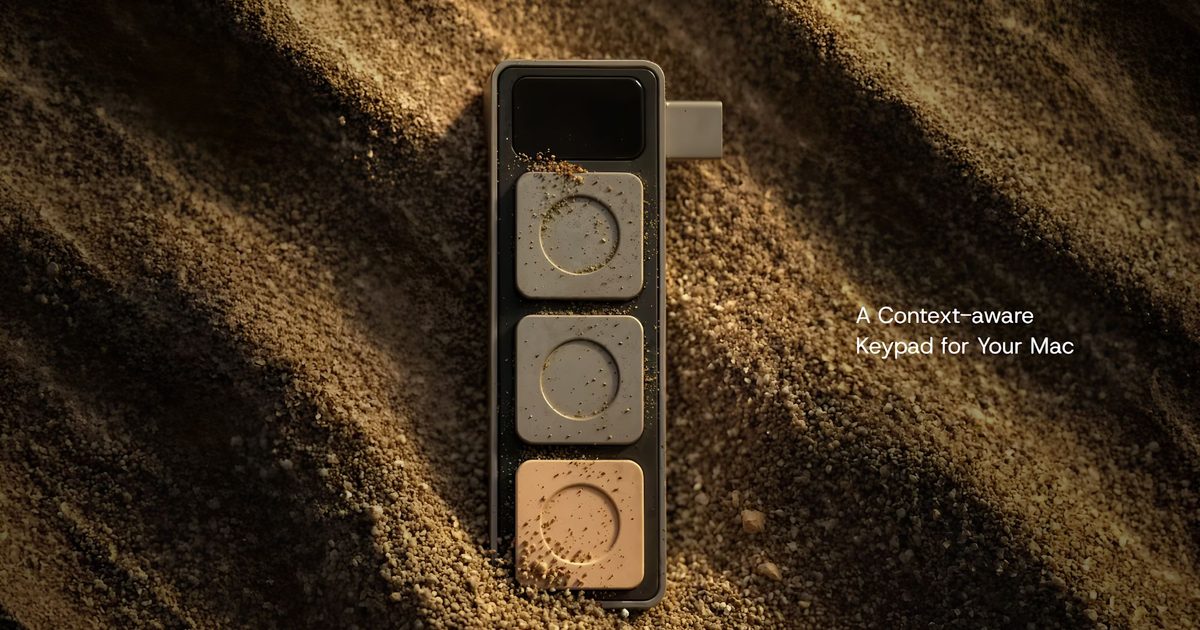
A new hardware accessory is looking to simplify one of the more frustrating aspects of using a MacBook: juggling different keyboard shortcuts across video calls, productivity apps, and development tools. The startup Project Mirage has unveiled Dune, a compact USB-C device that attaches to the side of compatible MacBooks and offers three dynamically programmable buttons. Unlike traditional macro keypads, Dune is built specifically for MacBooks, matching the laptop's design and plugging directly into a USB-C port without requiring batteries or separate power.
The core idea behind Dune is context awareness. Each of its three buttons can change function depending on the active application. For video conferencing tools such as Zoom, Microsoft Teams, or Google Meet, users may assign mute, camera toggle, or screen sharing. In spreadsheet software like Excel or Google Sheets, the same buttons become copy, paste, and undo. Developers working in Visual Studio Code or GitHub can map build, debug, or commit commands. This eliminates the need to memorize complex keyboard combinations or switch between multiple peripherals.
Project Mirage ships Dune with a companion application that allows users to create application-specific or system-wide shortcuts. Beyond simple keystrokes, users can configure buttons to launch applications, open websites, execute custom scripts, or trigger workflows. The app also integrates with calendar services, showing upcoming events and enabling one-press actions such as joining a call, dismissing reminders, or sending a 'running late' message.
One of the most distinctive features is Dune's integration with Claude Desktop, an AI assistant. Instead of manually writing automation scripts, users can describe their desired shortcut in natural language. For example, a user could say, 'When I press button 2 in Chrome, open Gmail and compose a new email to my team,' and Claude will generate the necessary Python code and assign it to the button. According to initial reviews, this makes creating advanced workflows accessible to users without programming experience, democratizing hardware customization.
Compatibility and Design
Dune is currently compatible with MacBook Air models powered by the M2 chip or newer, and MacBook Pro models with M1 Pro processors or later, all running macOS Sequoia 15 or newer. The device's form factor is tailored to each laptop, sitting flush against the side to avoid adding bulk. It draws power from the USB-C port, so there is no need for charging cables or extra batteries. The three buttons are tactile and responsive, designed for frequent use.
The hardware market for MacBook accessories has seen a surge in productivity-focused gadgets. Devices like the Touch Bar (discontinued by Apple) and various external macro pads have attempted to streamline workflows. However, Dune differentiates itself through its app-specific adaptability and AI integration. Rather than requiring manual profile switching, the companion app automatically detects the foreground application and updates button assignments accordingly. This seamless transition is crucial for users who multitask across different software throughout the day.
AI-Powered Customization
The integration with Claude Desktop is particularly noteworthy. While other macro pads often rely on pre-set scripts or manual configuration, Dune leverages natural language processing to generate custom actions. This lowers the barrier for non-technical users to automate repetitive tasks. For instance, a graphic designer could say, 'When I press button 3 in Photoshop, save the current file as JPEG and export it to my desktop,' and Dune would execute that sequence. As AI assistants become more capable, such integrations are likely to become standard in peripheral design.
Project Mirage has also hinted at future updates that could include support for more applications, cloud-based profiles, and deeper integration with other AI tools. The company is positioning Dune not just as a shortcut device, but as a platform for personal automation. The companion app's capability to execute Python scripts opens endless possibilities for power users.
Pricing and Availability
Dune is available at an introductory price of US $119, after which it will retail for US $149. This positions it competitively compared to other macro pads, many of which lack context awareness or AI features. The device is currently sold directly through Project Mirage's website and is expected to ship within a few weeks.
The broader trend of physical productivity tools is gaining momentum as remote and hybrid work persist. Users seek ways to reduce cognitive load and increase efficiency without disrupting their existing setups. Dune's approach of embedding hardware customization directly into the laptop's ecosystem addresses this need elegantly. It remains to be seen whether the concept will achieve widespread adoption, but early indicators are positive, especially among developers and power users who value streamlined workflows.
As AI-assisted productivity tools continue to expand beyond software, devices like Dune suggest hardware makers are exploring new ways to make everyday computer interactions faster and more intuitive. Whether the concept catches on will likely depend on how valuable users find its growing library of customizable shortcuts and automations. For now, Dune represents a clever fusion of hardware simplicity and AI intelligence, offering a glimpse into the future of personalized computing.
Source: Digital Trends News