

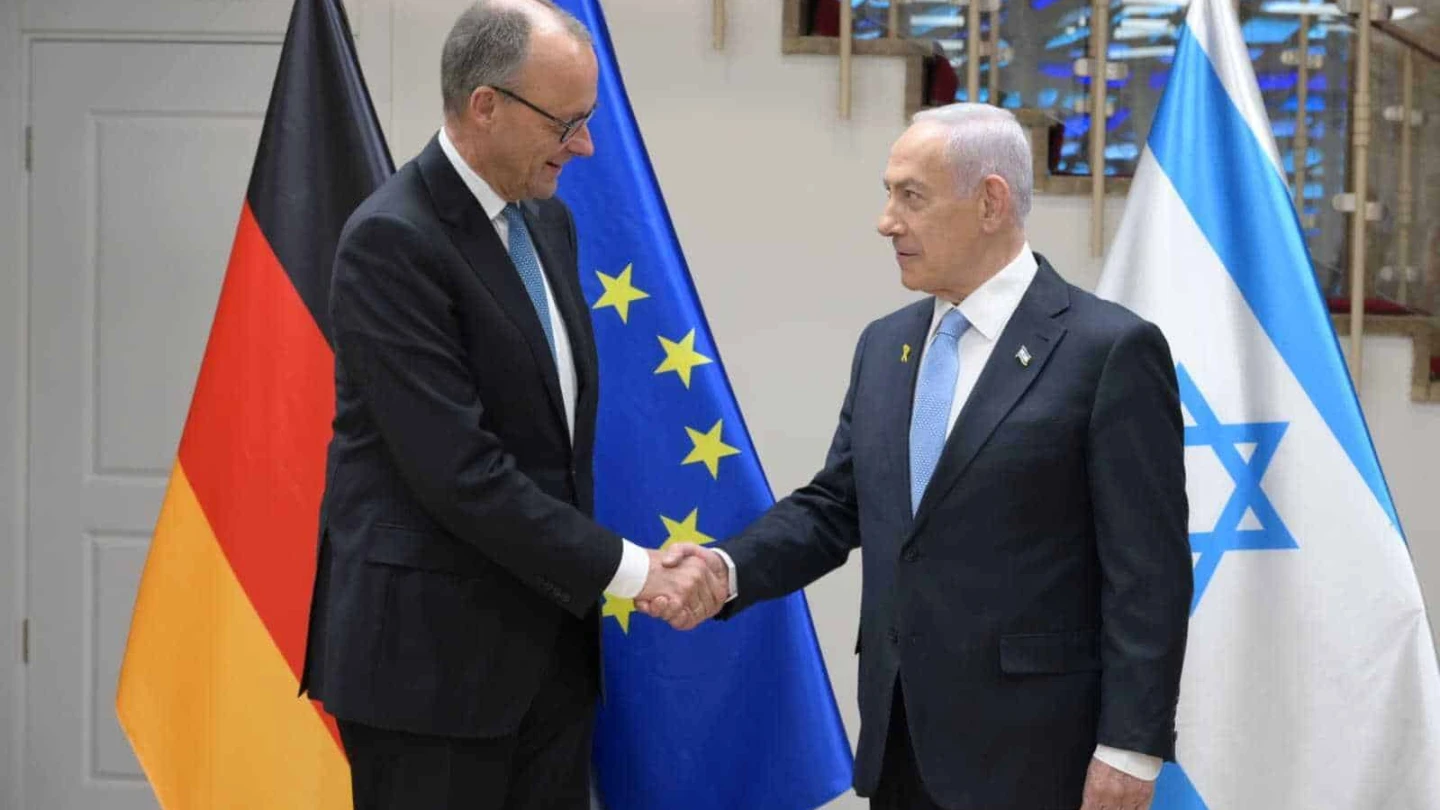
German Chancellor Friedrich Merz said in a televised question-and-answer session on Aug. 30 that Israel would “no longer exist” if not for German arms shipments, a comment that underscored Berlin’s self-declared role as a guarantor of Israeli security and immediately drew a backlash from Israelis who say that account of their country’s history is wrong.
Merz was speaking on ARD, Germany’s public broadcaster. He was asked why his government would keep approving defense exports to Israel despite criticism at home and abroad. “There are no unconditional deliveries to Israel,” he said. “But for as long as I bear political responsibility, we will always support the State of Israel’s right to exist, including militarily—because otherwise, that state would no longer exist today.”
A spokesperson for Merz’s office declined to say which weapons or policy decisions, in his view, had been decisive for Israel’s survival.
Israel pushes back against dependence narrative
Consecutive Israeli governments, led at different times by both center-right and center-left coalitions, have rejected the premise that the country’s survival depends on foreign generosity. Official Israeli discourse emphasizes the sacrifices of Israeli soldiers, the country’s technological strengths and the memory of a war of independence fought in 1948 against overwhelming odds.
Prime Minister Benjamin Netanyahu expressed the standard Israeli position in 2024, after the Biden administration briefly delayed some arms shipments. “If we have to stand alone, we will stand alone,” Netanyahu said. “If we need to, we will fight with our fingernails. But we have much more than fingernails.”
Asked about Merz’s comment, Israel’s Ministry of Foreign Affairs did not respond by press time.
Merz acknowledges a temporary arms halt
For decades, German leaders have described support for Israel as rooted in Germany’s historical responsibility for the Holocaust. But the policy has become politically difficult in Berlin since the Hamas-led attack on Israel on Oct. 7, 2023, and the subsequent wars in Gaza and Lebanon. German public opinion has become more critical of Israel, and arms export decisions are now watched closely by lawmakers from several parties.
Merz used the ARD appearance to defend not only Germany’s overall policy but his own decision in August 2025 to suspend the supply of some ammunition. “I acknowledge that last August I made a decision that was heavily criticized,” he said. “At a time when the Israeli military was acting forcefully against the civilian population in the Gaza Strip, I decided to stop supplying ammunition to the part of the military involved.”
The suspension was temporary. In the same interview, Merz explained why he still regards military support for Israel as indispensable. “Israel is the only democracy in the entire Middle East,” he said, adding that the country is threatened by neighboring states and by Iran and its proxies. Since the founding of the Federal Republic of Germany, he said, Germans have supported “Israel in its struggle for survival.” The existence of the State of Israel, he added, is “non-negotiable” for Germany.
Trump has made similar claims
Merz is not the only Western leader to frame Israel’s survival around his own country’s assistance. President Donald Trump said on June 16, while appearing at the Group of Seven summit with the president of the United Arab Emirates, that “without the U.S., there would be no Israel.” He also said: “Without me, there would be no Israel because no other president was willing to do what I did.” Israel, he claimed, “would have been blown up a long time ago” without his intervention.
In Israel, comments like those are often seen as election talking points or as a way to pressure Israeli governments rather than as accurate history. Israeli defense officials publicly acknowledge the value of American and German systems, but they also point to Israel’s domestic defense industry and to years in which the country operated with no formal alliance and very limited foreign arms supplies.
Roots of Germany’s special relationship with Israel
The German-Israeli relationship did not begin with arms sales. In 1952, Israel and West Germany signed the Luxembourg Reparations Agreement, under which West Germany agreed to pay billions of deutsche marks to the young state and to Holocaust survivors. The money helped Israel absorb hundreds of thousands of Jewish refugees from postwar Europe and from the Middle East. Formal diplomatic relations followed in 1965.
Former German Chancellor Angela Merkel delivered the classic formulation of modern German policy in a 2008 speech to the Knesset. She said the security of Israel is part of Germany’s “Staatsräson,” or reason of state, a fundamental national interest rooted in Germany’s unique responsibility for the murder of six million Jews.
That language remains central to German political culture. Both Merz and his predecessor, Chancellor Olaf Scholz, used similar formulations after Oct. 7. Almost three years later, however, actual export policy is still subject to legal review and to intense public debate.
Historians and analysts challenge Merz’s formulation
Rafael Medoff, founding director of the David S. Wyman Institute for Holocaust Studies in Washington, D.C., said Merz overstated Germany’s role. “Germany only began selling significant quantities of weapons to Israel in 1962,” Medoff said. “Israel existed for many years before it could buy German weapons, and it would continue to exist even if Germany were to re-impose the recent arms embargo.”
Source: Israel & Jewish News - JNS News