

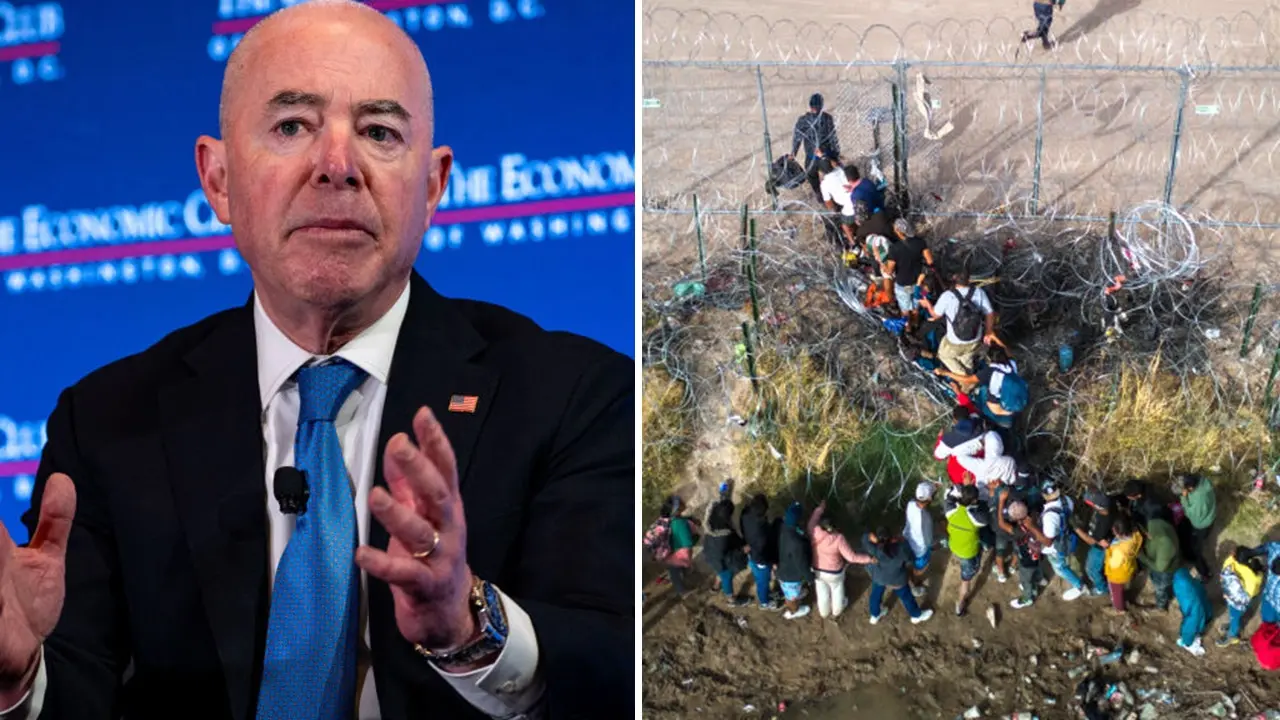
Homeland Security Secretary Alejandro Mayorkas acknowledged on Friday that more migrants have crossed the U.S. southern border under President Joe Biden than under the administration of former President Donald Trump, conceding that “several million people” have been encountered during his tenure.
Speaking at an event hosted by The Economic Club in Washington, D.C., Mayorkas was questioned by David Rubenstein, the club’s president, about the historic migrant influx that has defined the Biden administration. Rubenstein directly asked whether it was true that more people had entered the country under Biden than under Trump. “That is true,” Mayorkas responded, without hesitation.
The admission comes as border encounters remain elevated despite recent monthly declines. In fiscal year 2023 alone, U.S. Customs and Border Protection (CBP) recorded more than 2.4 million migrant encounters at the southwest border, nearly matching the record set the previous fiscal year. Encounter totals have repeatedly shattered historical benchmarks during the Biden presidency, fueling intense political debate over immigration policy.
Mayorkas cites global factors and domestic demand
During the event, Mayorkas stressed that the challenge of migration is not confined to the United States-Mexico border. “From a context perspective, the world is seeing the greatest level of displacement since at least World War II,” he said. He attributed the surge to violence, insecurity, poverty, corruption, authoritarian regimes, and extreme weather events that have displaced populations across the globe.
He also pointed to the United States’ rapid post-COVID recovery as a draw for migrants. “In our hemisphere, we overcame COVID more rapidly than any other country. We had, in a post-COVID world, 11 million jobs to fill, we are a country of choice as a destination,” Mayorkas explained. Combined with what he called a “fundamentally broken” immigration system, these forces have contributed to the high level of encounters at the southern border.
As evidence of the system’s dysfunction, Mayorkas noted that the average time between a migrant’s initial encounter and the adjudication of an asylum claim is now seven years. This backlog has overwhelmed immigration courts and left hundreds of thousands of cases pending, creating incentives for migrants to enter illegally rather than wait for legal processing.
Comparing administrations
Rubenstein’s question highlighted a politically sensitive comparison between the Trump and Biden years. During the Trump administration, border encounters spiked in fiscal 2019, with nearly 978,000 apprehensions reported, a significant increase from 2018. However, in 2020, the onset of the COVID-19 pandemic led to a dramatic suppression of migration globally. Trump-era policies, including the Migrant Protection Protocols (MPP) and Title 42 public health expulsions, also reduced border crossings during that period.
Under the Biden administration, encounters have consistently exceeded 1.5 million per year, with record-breaking numbers in fiscal 2022 and 2023. The administration’s rollback of several Trump-era policies, including the termination of MPP, was widely criticized by Republicans who argued that it encouraged illegal immigration. Mayorkas, however, maintained that the root causes of migration are global and cannot be attributed solely to any single administration.
“In the 2019 period, there was almost a 100% increase in the number of encounters over 2018. The situation in the hemisphere was propelling people to leave their country. 2020 was a period of tremendously suppressed migration throughout the hemisphere and around the world because of the COVID-19 pandemic,” Mayorkas said, explaining why the comparison to the pre-pandemic Trump years is incomplete without context.
Recent enforcement numbers and administration defense
Despite the overall high numbers, the Biden administration has pointed to recent reductions in encounters. In April, CBP reported 179,725 encounters at the southern border, a decrease compared to 211,992 in April 2023 and 189,357 in March. Administration officials have attributed this decline, in part, to enhanced enforcement measures and new legal pathways introduced over the past year.
Since May 2023, the administration says it has conducted or facilitated more than 720,000 removals and returns of illegal immigrants, a figure it claims exceeds the totals for every full fiscal year since 2011. DHS has also expanded access to legal migration programs, such as humanitarian parole for nationals of certain countries, and has partnered with regional governments to address migratory pressures.
Mayorkas reiterated the administration’s position that comprehensive immigration reform is needed, but acknowledged that legislative action has been elusive. A bipartisan Senate border security bill, unveiled earlier this year, failed to advance amid opposition from both progressive and conservative factions. The bill would have provided additional funding for enforcement and created new authorities to expedite asylum screenings, but critics argued it did not go far enough or went too far in certain provisions.
Republican backlash and impeachment effort
Republican lawmakers have long accused the Biden administration of engineering the border crisis through executive actions that dismantled Trump-era enforcement policies. House Republicans passed their own border security bill, known as the Secure the Border Act, which would restart construction of the border wall, restrict asylum eligibility, and increase funding for enforcement. That measure has not been taken up by the Democratic-controlled Senate.
In February, House Republicans also voted to impeach Mayorkas over his handling of the border, charging him with willful and systemic refusal to enforce immigration law. The articles of impeachment were delivered to the Senate, but have not yet been considered in a trial. Mayorkas has dismissed the impeachment effort as a political stunt, and Senate Majority Leader Chuck Schumer has not indicated whether a trial will be held.
Republicans, including Senator Lindsey Graham, have characterized Mayorkas’ admission as a de facto confession that his policies have facilitated illegal immigration. “This is the first time a Cabinet secretary has admitted in public that his policies have led to millions of illegal crossings,” Graham said in a statement following the event. Other GOP voices echoed Graham, calling for Mayorkas’ resignation or removal.
State and local impact
The border crisis has reverberated beyond Washington. Texas, Arizona, and California have shouldered the immediate burden of increased crossings, prompting governors to deploy National Guard resources and install additional barriers. Texas Governor Greg Abbott has bused thousands of migrants to sanctuary cities nationwide, a move that has sparked legal battles and drawn attention to the strain on local resources.
In border towns like El Paso, Texas, and Yuma, Arizona, local officials have cycled through states of emergency, opening temporary shelters and appealing to the federal government for assistance. Humanitarian aid organizations have worked to provide food, clothing, and medical care to migrants in crowded facilities, while also raising concerns about the conditions in CBP holding cells.
The political fallout has also influenced the 2024 presidential campaign. Polls consistently show immigration as one of the top issues among voters, particularly in swing states. President Biden has attempted to shift blame to congressional inaction, urging lawmakers to pass comprehensive reform. Former President Trump, meanwhile, has made border security a centerpiece of his campaign, promising to restore and expand his previous policies.
Global and humanitarian context
Mayorkas’ remarks also underscored the global nature of migration. The United Nations High Commissioner for Refugees has reported record levels of forced displacement worldwide, driven by conflicts in Ukraine, Sudan, Afghanistan, and parts of Latin America, as well as climate-related disasters. Many migrants traveling to the U.S. border come from countries such as Venezuela, Nicaragua, Cuba, and Haiti, where economic collapse and political repression have made daily life untenable.
Human rights groups have urged the U.S. to maintain asylum protections, while also calling for more orderly and humane processing. At the same time, the vast majority of encounters involve single adults, many of whom are seeking economic opportunities rather than asylum. The distinction has complicated efforts to screen claims quickly and efficiently.
The intersection of global displacement and U.S. domestic policy ensures the border remains a flashpoint. Mayorkas, for his part, did not offer a new policy prescription on Friday. Instead, he repeated the administration’s existing approach: ramping up enforcement when possible, expanding legal pathways, and pressing for congressional action. “The challenge of migration is not exclusive to the southern border, nor to the Western Hemisphere. It is global,” he said.
The DHS secretary’s comments underscore the complexity of a border system under exceptional strain. While monthly numbers have dipped from their peaks, the overall trend under the Biden administration remains historically high. Until the immigration system is substantially reformed, officials acknowledged, the pressures are unlikely to abate. For now, the administration continues to pursue a mix of enforcement and deterrence, even as critics and supporters alike debate what the true meaning of “several million people” entails for national security, humanitarian obligations, and the rule of law.
Source: Fox News News