

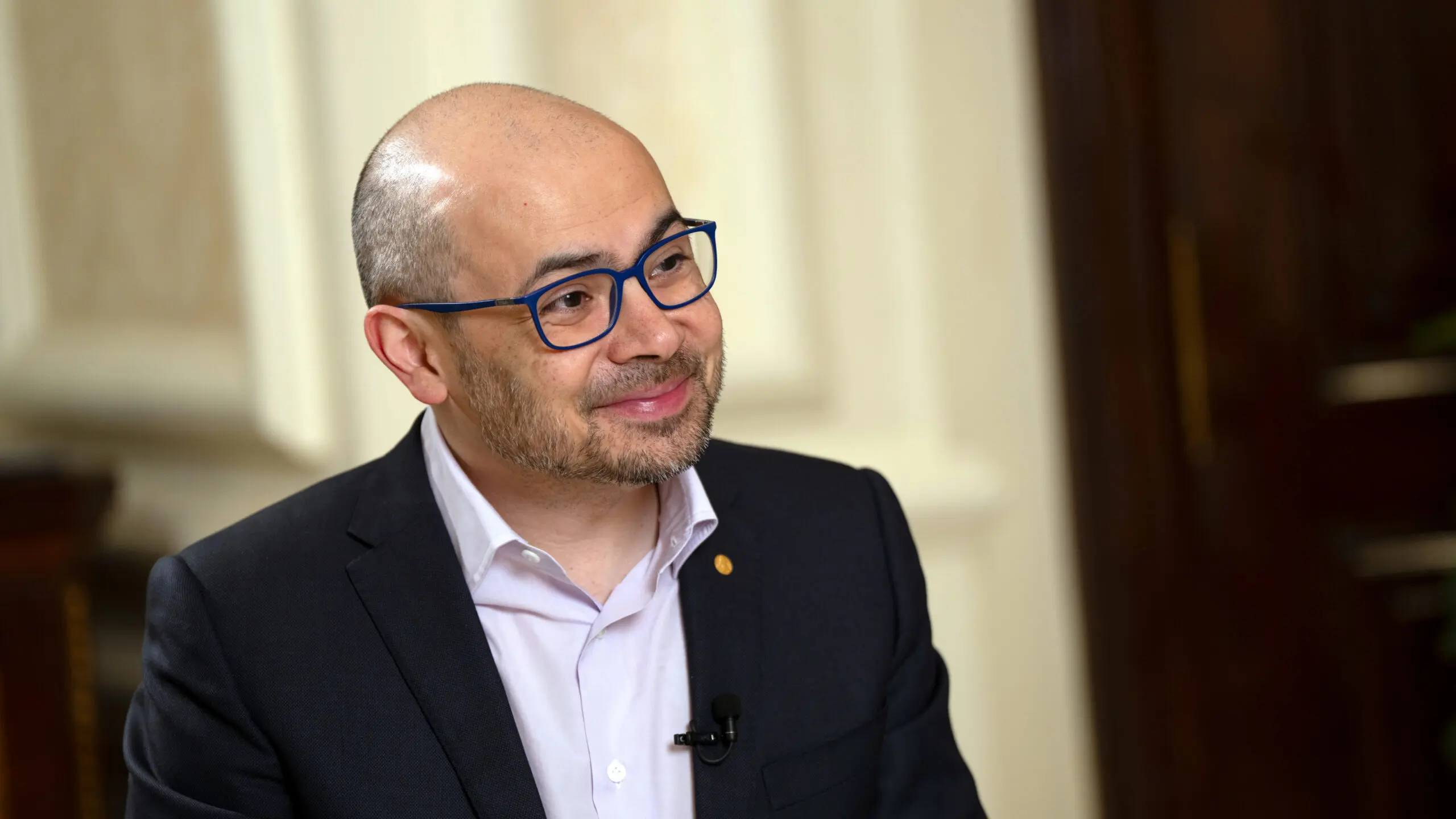
Google got a slow start with generative AI after being seemingly caught flat-footed by Microsoft’s Copilot reveal. What a difference a few years make. Now, Google is at the forefront of AI development, for better or worse, but new cracks are beginning to show. The company’s string of high-profile personnel departures continues, and DeepMind CEO Demis Hassabis has now said he will hand off day-to-day responsibilities to take on an oversight role at parent company Alphabet.
Hassabis was one of the founders of DeepMind, and he maintained a key leadership role after Google acquired it. As the generative AI boom took off, Hassabis has been one of the loudest voices predicting the impending creation of artificial general intelligence, or AGI, which is typically described as an AI with human-like capabilities and intelligence. In his memo announcing his decision to leave DeepMind, Hassabis again leans on the promise of AGI. “I’ve been working towards AGI my whole life and now, like many of you, I feel it is close at hand,” said Hassabis.
According to Hassabis, this shift will allow him to focus on the “big picture” work that is necessary at this moment. He will remain in charge of Google’s Isomorphic Labs, which uses AI to solve biomedical problems. The daily operation of DeepMind, which works on the underlying AI research that fuels all of Google’s Gemini advances, will be handed off to Koray Kavukcuoglu. He will serve as DeepMind’s senior vice president, reporting directly to CEO Sundar Pichai. Hassabis, meanwhile, is becoming the chair of DeepMind and chief scientist at Alphabet.
Four senior researchers depart
While Hassabis is keeping his badge, some other prominent Google personnel have coincidentally announced their departure from the company at the same time. Key AI researchers Quoc Le, Oriol Vinyals, Jeff Dean, and Sanjay Ghemawat have decided to leave Google to found a startup called Discovery Loop. The startup’s goal is to use AI technology to automate scientific discovery. According to a detailed report from Wired’s Steven Levy, the company was funded largely based on the sterling reputation of its founders.
Both Ghemawat and Dean are early Google hires who have left their mark on the company. Dean, in particular, is widely respected—you might even say idolized—within the company. As Google employee number 30, he had a hand in designing the systems that made Google search into the global information indexing powerhouse that it is today. Googlers even maintain an apocryphal list of “Jeff Dean Facts” that you can review on GitHub.
More recently, Dean and Vinyals played a key role in designing Google’s Gemini AI models. Dean has also reportedly been among a group of employees pushing back on the company’s increased closeness with the Trump administration. Unlike Google, Discovery Loop is structured as a public benefit corporation, a for-profit entity intended to focus on public good. Both OpenAI and Anthropic have similar structures, so that detail alone does not guarantee a different path.
A troubling trend
Google’s announcement of the shake-up was framed in the typically cheery, PR-vetted language you would expect when something goes wrong. The report from Levy notes that Google CEO Sundar Pichai tried mightily to keep the group, especially Dean and Ghemawat, from leaving. After “multiple meetings” with Pichai, the four decided to move forward with their plans to exit.
In a vacuum, these changes might not look so bad. After all, Hassabis isn’t leaving the company, and Google has a deep bench of AI talent. But this isn’t the only change in Google’s roster of late. Earlier this summer, Google saw a string of high-profile departures, including Noam Shazeer, Google’s previous vice president of engineering and a co-lead of Gemini.
Shazeer was the lead author of the seminal 2017 paper “Attention Is All You Need,” which first described the transformer architecture that powers today’s expansive generative AI systems. He’s now at OpenAI, a real coup for the Google rival. Around the same time, Google DeepMind VP John Jumper announced he was leaving for Anthropic. Jumper is famous in AI circles for his role in creating the protein-folding AI known as AlphaFold. He was soon after joined at Anthropic by senior DeepMind researchers Jonas Adler and Alexander Pritzel, who were reportedly instrumental in getting Gemini off the ground.
Leadership churn and a delayed roadmap
Pichai’s statement on the changes emphasizes Google’s strong position. “We’ve got amazing talent, world-class compute, and products that bring AI to more people than any other company,” said Pichai. Yet those words have been tested by the steady churn of top researchers and engineers. When a company loses not only its DeepMind founder but also the architects of its core models, institutional memory and technical momentum are hard to replace, no matter how deep the bench.
These staffing changes happen against a backdrop of slowing progress. After rapidly closing the gap between Gemini and other frontier models last year, Google now appears to be lagging. At I/O this spring, Google said it planned to release Gemini 3.5 Pro, its latest frontier model, in June. However, months later, users have only received new, lower-power Flash models. In the meantime, OpenAI and Anthropic have both rolled out new models that have dominated the conversation.
The timing of the departures is particularly awkward for Google. DeepMind has been the engine behind the company’s most ambitious AI efforts, from AlphaFold to the Gemini line of large language models. With Hassabis moving to a broader Alphabet role and several key researchers leaving to start Discovery Loop, Google’s AI roadmap is at risk of losing its most visible leaders at a moment when competition is intensifying.
Discovery Loop’s focus on automating scientific discovery is not entirely separate from the work that several of the founders pursued at Google. Quoc Le has been a central figure in deep learning research, contributing to early work on convolutional neural networks, sequence-to-sequence learning, and neural architecture search. Oriol Vinyals, who led the Gemini project alongside others, has a background in both machine translation and reinforcement learning. Sanjay Ghemawat and Jeff Dean have long been known for building the distributed systems that underpin Google’s massive infrastructure, including MapReduce, BigTable, and Spanner.
For a startup, having founders with that kind of combined expertise is remarkable. Their reputations alone appear to have attracted substantial funding, but the real challenge will be translating broad ambition into a sustainable research culture. The public benefit corporation structure suggests an intention to prioritize fundamental science over commercial pressure, though the recent history of similar entities shows that market forces remain powerful.
Meanwhile, Google is trying to reassure both investors and users that the departures will not derail its progress. Historically, the company has weathered major talent losses. Shazeer’s return to OpenAI is a reminder that even the most influential researchers can shift allegiances, and the exodus to rival labs has accelerated across the broader AI field. OpenAI, Anthropic, and a growing list of well-funded startups have all poached top researchers from Google and DeepMind in the past few years.
At DeepMind, Koray Kavukcuoglu now faces the enormous task of maintaining continuity in a research organization that has thrived on a strong top-down vision. Hassabis’s presence as chair may ease the transition, but his day-to-day absence will inevitably change the dynamics inside the lab. Kavukcuoglu has been with DeepMind for over a decade and has contributed to breakthroughs across reinforcement learning and deep neural networks, but this is his first time at the helm of the entire organization.
There is also the question of how Google’s AI strategy will evolve under a chief scientist who is no longer running DeepMind. Hassabis has repeatedly argued that AGI is close, and his new role at Alphabet likely gives him more latitude to shape the company’s broader scientific agenda. Yet the practical details of shipping products, refining Gemini, and keeping up with faster-moving rivals will fall to others.
For now, Google remains one of the most important players in AI, with massive compute resources, an unmatched distribution network, and a research arm that has produced some of the field’s foundational innovations. But the steady stream of departures, combined with a quiet product roadmap, points to a company in transition. The next few months will show whether the new leadership structure can hold things together or whether the cracks that have emerged will turn into a wider fracture.
Source: Ars Technica News