

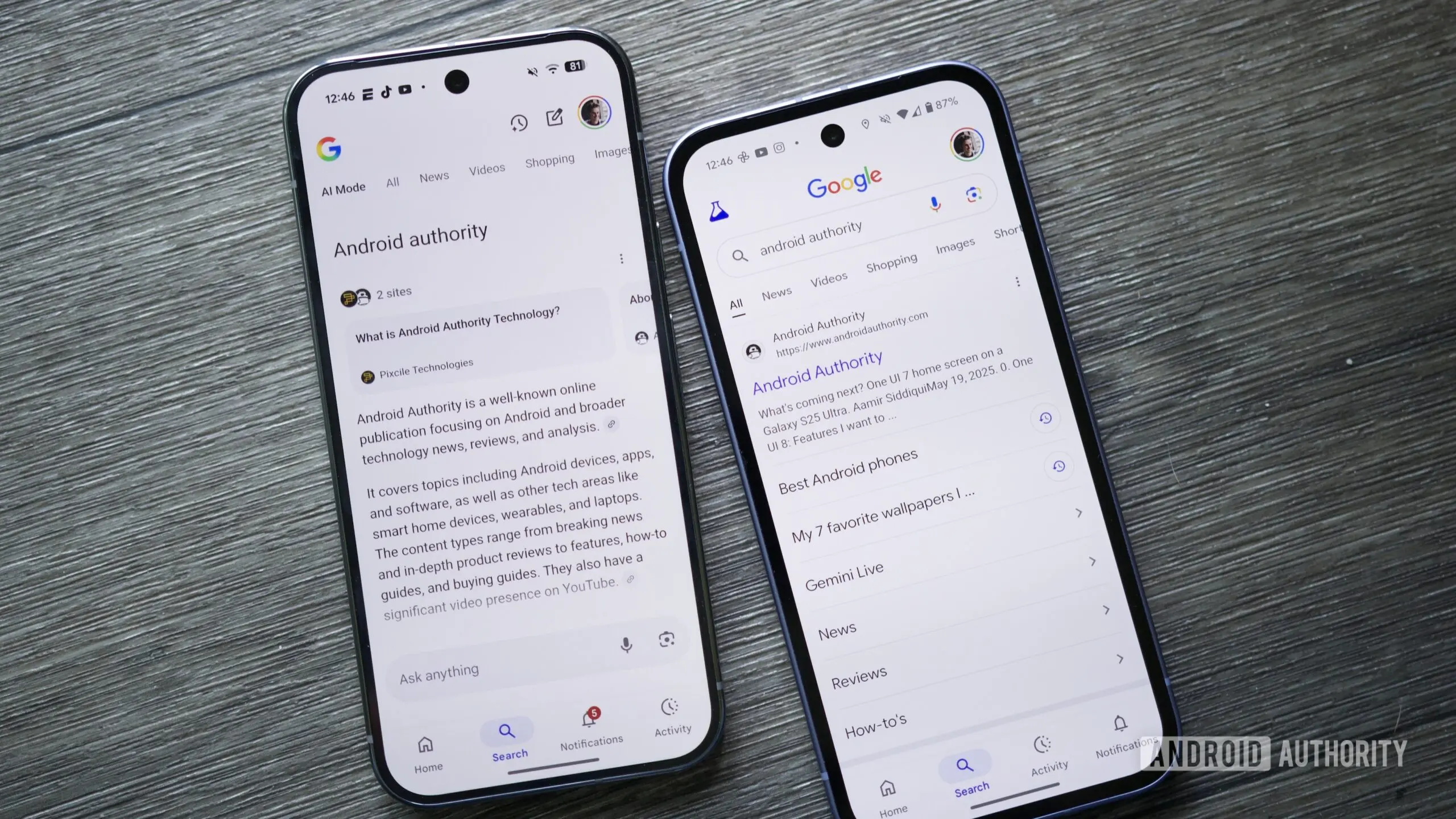
Google is continuing its aggressive push toward an AI-first search experience, and the latest change makes that strategy even harder to miss. For some search queries, the company is now automatically expanding its AI Overviews to their full length, complete with a text prompt that invites users to start an AI Mode conversation. The change is subtle but significant, as it transforms the traditional search results page into something that looks much more like a chatbot interface.
The expanded AI Overviews appear on desktop for certain queries, particularly those that ask for definitions. Instead of seeing a truncated summary with a "Show more" button, users are now greeted by a lengthy AI-generated answer that occupies most of the viewport. At the end of that answer, a text box labeled "Ask anything" appears, giving users a direct invitation to continue the conversation in Google's AI Mode.
What changed with AI Overviews?
Previously, the "Ask anything" text box was only visible after users clicked the "Show more" button at the bottom of an AI Overview. That design kept the AI content somewhat contained, allowing users to quickly skip to traditional organic results. The new behavior removes that barrier. Now, for at least a subset of queries, the AI Overview is fully expanded by default, and the follow-up prompt is immediately visible.
The change was first noticed by an SEO analyst who shared a screenshot on X (formerly Twitter). The post showed a search for the word "algorithmic" returning a fully expanded AI Overview with the "Ask anything" box already visible. In testing, the same behavior appeared for any search that asked the desktop version of Google to define a term. The summary often spans the entire browser window, forcing users to scroll in order to see the list of linked search results below.
Desktop versus mobile
So far, the change appears to be limited to desktop. On mobile, the same search terms still return the older, truncated AI Overview format. The "Ask anything" box only appears after tapping the "See more" button. This suggests Google is testing the expanded format on desktop as it evaluates user engagement and potential impact on organic click-through rates.
Desktop users are more likely to be in a research or work context, which may explain why the company chose that platform for the experiment. A larger screen allows for a more immersive AI experience, and users may be more willing to interact with a follow-up prompt when they are seated at a keyboard. On mobile, real estate is more limited, and Google may be cautious about pushing AI content too aggressively.
The broader push toward AI Mode
AI Mode is Google's dedicated conversational interface within Search, launched after a period of testing and refinement. It allows users to ask complex, multi-part questions and receive synthesized answers drawn from across the web. The mode is designed to compete with AI chatbots like ChatGPT and Perplexity, which have gained popularity by offering direct answers instead of links.
Google has been gradually weaving AI Mode into the search experience. The company introduced AI Overviews in 2024, rolled out new AI-formatted results pages for some queries, and has been adding more generative features to Search. The appearance of the "Ask anything" box by default is the latest step in that integration, making it easier than ever for users to transition from a standard search to a full AI conversation.
A quick history of Google's AI search
Google's journey into generative search began long before AI Mode existed. The company started experimenting with machine learning in ranking algorithms, but the public launch of large language models changed the game. In 2023, Google introduced Bard, its first standalone AI chatbot, which was later rebranded as Gemini. That technology formed the backbone of AI Overviews, which began rolling out to US users in May 2024.
AI Overviews were initially met with mixed reactions. Early on, they generated some high-profile errors, causing Google to pull back and refine the system. Over time, the quality improved, and Google began expanding the feature to more countries and more types of queries. In 2025, the company launched AI Mode as a separate tab in Search, offering a more advanced conversational experience for power users.
Since then, AI Mode has evolved from an experimental opt-in feature to a core part of Google's search vision. The company has repeatedly emphasized that AI is not a replacement for Search but an enhancement. However, the increasing prominence of AI-generated content on the results page suggests that the line between the two is blurring.
How AI Overviews work
AI Overviews are generated by Google's Gemini models, which synthesize information from multiple sources to produce a single answer. The summaries are designed to provide quick answers to simple queries while still offering links to the underlying pages. Originally, the summaries appeared in a collapsed format, with a "Show more" button allowing users to expand them if desired.
The new expanded format blurs the line between an answer and a conversation. When the "Ask anything" box is visible by default, it encourages users to think of Search as a dialogue rather than a directory. This has significant implications for how people interact with the search engine and how website owners think about visibility.
Impact on search behavior and SEO
The shift toward AI-generated answers has already changed the landscape of search engine optimization. If users can find the information they need directly in an AI Overview, they are less likely to click through to a website. Expanded AI Overviews increase the likelihood that users will stay on the page, especially when the "Ask anything" box invites further interaction.
For publishers and content creators, this is a worrying trend. The more Google integrates AI-generated content into the search results page, the less traffic flows to websites. Even if a site is cited as a source in the AI Overview, users rarely scroll down to visit the original page. The new default expansion only accelerates this trend.
SEO experts have pointed out that the change effectively hides organic results below the fold. A fully expanded AI Overview can take up an entire screen, meaning users must scroll past the AI content to see the traditional blue links. This reduces the visibility of even the top-ranking websites and could have a measurable impact on click-through rates.
Why Google is making this move
Google's motivations are clear. The company faces intense competition from AI-native search tools, which offer a more conversational experience. By making AI Mode more accessible, Google hopes to keep users within its own ecosystem instead of changing to a rival platform. The "Ask anything" box acts as a bridge, converting a simple search into an ongoing AI session.
There is also a strategic element related to advertising and data. The longer a user stays engaged with Google's AI, the more opportunities the company has to show ads and collect behavioral signals. AI Mode allows for more complex queries, which can yield richer data about user intent. Expanded AI Overviews serve as a gateway to that deeper engagement.
User response and potential backlash
Not all users are happy with the change. Many prefer traditional search results because they are faster and more transparent about sources. AI Overviews have also been criticized for generating inaccurate information, sometimes in a confident tone that makes errors difficult to spot. The expanded format gives the AI answer more prominent placement, which could amplify concerns about misinformation.
On the other hand, some users appreciate the convenience. The ability to ask follow-up questions without leaving the search page is genuinely useful for research tasks. The "Ask anything" box turns a simple definition into an interactive learning session, which can be more efficient than opening multiple tabs.
What this means for the future of search
This change is likely just the beginning. If the expanded AI Overview format proves successful on desktop, it will probably roll out to mobile and to a wider range of query types. Google has been steadily pushing AI features forward, and the direction of travel is unmistakable: the search results page is becoming an AI assistant.
For now, the expanded format appears to be limited to definitional queries on desktop. But as Google continues to test and refine, the "Ask anything" box may become a permanent fixture for a much broader set of searches. The line between search engine and chatbot is becoming increasingly thin, and Google is clearly aiming to make AI Mode the default experience for millions of users.
For website owners and digital marketers, the takeaway is that adaptation is essential. Relying on organic search traffic alone may become more difficult as AI-generated answers consume more of the search results page. Building a strong brand, creating unique content, and diversifying traffic sources are all strategies that will become even more important in the AI era.
Source: Android Authority News