

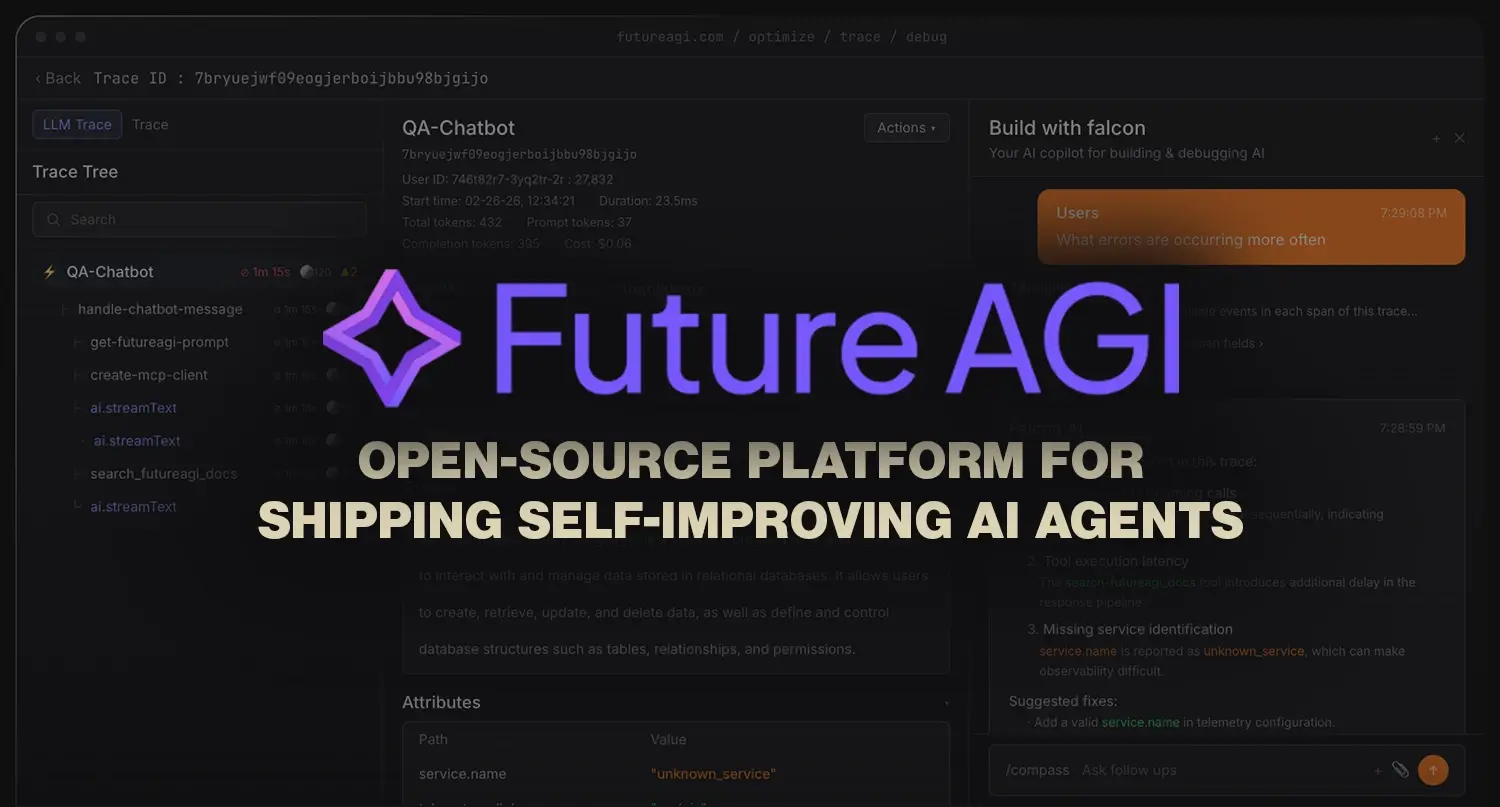
Future AGI is an open-source platform designed for teams that want to ship self-improving AI agents with confidence. It provides a unified toolset for tracing, evaluating, simulating, and guardrailing large language model (LLM) agents. The platform is licensed under Apache 2.0 and can be self-hosted, giving organizations full control over their data and infrastructure. With the rise of agentic AI systems, observability and safety have become critical, and Future AGI aims to address both in one package.
What is Future AGI?
Future AGI is essentially a complete operational layer for LLM agents. It helps developers and platform teams understand what their agents are doing, why they are doing it, and how to keep them aligned with intended behavior. The platform combines data collection, evaluation workflows, simulation environments, and security scanning in a single, self-contained deployment. Because it is open source, organizations can inspect every component, modify it to suit their needs, and avoid vendor lock-in.
The platform is built for real-world agent deployments. It does not simply log prompts and responses; it tracks the full context of an agent's reasoning, including tool calls, intermediate steps, and external data interactions. This makes it possible to replay an entire agent session, identify failure points, and iterate on prompts or tool configurations. For teams shipping production agents, this level of visibility is no longer optional.
Telemetry and privacy considerations
One of the first things operators will notice about Future AGI is its telemetry behavior. According to the project documentation, self-hosted instances register with Future AGI on first boot. This registration sends an instance ID, a version string, a deployment type, and the email addresses and domains of active admin users. That registration fires once, before anyone signs in to the dashboard, which is an important detail for privacy-conscious teams.
There is an opt-out mechanism, but it must be set before the first start. The environment variable FUTURE_AGI_TELEMETRY_DISABLED=1 should be placed in the .env file ahead of launching the platform. If that window is missed, the admin list has already left the network. Future AGI explicitly lists air-gapped and on-prem deployment as supported and phone-home free, but the wording suggests that operators need to be proactive.
Disabling telemetry leaves one census ping that carries the instance ID, version, and deployment type, with email addresses withheld. Periodic heartbeats stop once telemetry is disabled. The project's telemetry section closes with a direct line for operators: "turn networking off at the edge if you need full silence." This is a pragmatic reminder that even with telemetry disabled, network-level isolation is the only way to guarantee zero external communication.
What the install holds
The Future AGI installer brings up a stack of well-known infrastructure components behind a dashboard on localhost:3000. The default deployment includes ClickHouse, PostgreSQL, Redis, RabbitMQ, and Temporal. Each component plays a specific role in managing and scaling agent workloads.
ClickHouse is used as the analytics database where trace and span data land. This columnar database is optimized for querying large volumes of event data, making it well-suited for agent observability. PostgreSQL serves as the primary relational store for application metadata, configuration, and user information. Redis is used for caching and real-time data structures, while RabbitMQ handles message queuing between services. Temporal provides durable execution workflows, which is essential for coordinating long-running agent tasks and ensuring fault tolerance.
The data flow is designed to capture as much context as possible. Spans land in ClickHouse after passing through the tracer. Prompt text, model output, and tool calls pass through the tracer on the way into that store. This means that every interaction with an underlying LLM is recorded, along with the tool results that influenced the final output. For debugging and evaluation, this is a goldmine.
Broad framework support through OpenTelemetry
Future AGI does not require teams to abandon their existing agent frameworks. Instrumentation covers more than 50 agent frameworks, including LangChain, LlamaIndex, CrewAI, and DSPy, all through OpenTelemetry. This is a significant advantage because the agent ecosystem is fragmented. Teams might use LangChain for one project, LlamaIndex for another, and CrewAI for multi-agent orchestration. Future AGI provides a consistent observability layer across all of them.
OpenTelemetry is becoming the standard for telemetry collection in cloud-native applications. By building on this standard, Future AGI ensures interoperability with other observability tools and future-proofs the platform. The tracing data can be exported and analyzed using a variety of backends, not just ClickHouse. This flexibility is important for organizations that already have monitoring infrastructure in place.
The sheer number of supported frameworks also lowers the barrier to adoption. Teams do not have to rewrite their agents from scratch to get visibility. They can add Future AGI instrumentation to their existing codebase and start collecting traces immediately. The platform also supports custom instrumentation for frameworks that are not natively covered, giving advanced users the ability to extend the system.
The gateway sits in front of everything
One of the most compelling components of Future AGI is the Agent Command Center, an OpenAI-compatible proxy that fronts more than 100 providers. This gateway centralizes all interactions with external model APIs. It supports routing strategies, semantic caching, virtual keys, and the emerging A2A (agent-to-agent) and MCP (Model Context Protocol) standards.
Every provider credential in a deployment terminates at the gateway. This is a security win because it means API keys never need to be exposed to individual agent processes. Instead, agents connect to the gateway, and the gateway handles the authentication with upstream providers. Virtual keys allow teams to issue scoped credentials to different agents or users, making it easier to audit usage and enforce quotas.
Routing strategies are particularly useful for managing cost and performance. Teams can define rules that send certain requests to cheaper models, or route high-priority requests to more capable models with lower latency. Semantic caching, meanwhile, can reduce the number of duplicate API calls by identifying semantically similar prompts and returning cached responses. This can significantly lower costs in production workloads.
The support for MCP and A2A reflects the growing movement toward standardized agent communication. MCP provides a universal protocol for connecting agents to tools and data sources. A2A addresses how agents discover and communicate with each other. By supporting these standards natively, Future AGI positions itself as a forward-looking platform that can handle the next generation of multi-agent systems.
Security: scanners and guardrails
Future AGI includes a security module called Protect, which ships with 18 built-in scanners. These scanners target a variety of threats, including personally identifiable information (PII), jailbreak attempts, and prompt injection attacks. In addition to the built-in scanners, the platform offers vendor adapters that integrate with Lakera, Presidio, and Llama Guard.
The scanners can run inline in the gateway or standalone through the SDK. Inline scanning is critical for real-time threat prevention. The project claims that its benchmark harness shows inline scanning holds P99 latency at or under 21 milliseconds. That is a strong performance guarantee, as latency budgets for agent interactions are often tight. A 21 millisecond overhead is unlikely to be noticed by end users.
The choice of vendors is notable. Presidio is a well-known open-source library for PII detection, while Llama Guard is Meta's model-based safety classifier. Lakera is a commercial AI security platform. By offering adapters for both open-source and commercial tools, Future AGI gives organizations the flexibility to plug in the protection mechanisms that best fit their risk profile.
The fact that Protect inherits the access controls on the underlying database is an additional security benefit. The defenders that scan and filter traffic are subject to the same access control policies as the traces themselves. This prevents accidental exposure of sensitive data and ensures that security measures cannot be bypassed by simply querying the database directly.
Practical implications for agent teams
The combination of tracing, evaluation, simulation, and guardrailing makes Future AGI a comprehensive platform for agent lifecycle management. The evaluation component is particularly important for self-improving agents. If an agent is designed to learn from its own experiences, the platform must provide a way to measure whether those experiences improve performance or degrade it. Future AGI's evaluation tools allow teams to define metrics, run tests, and compare different agent versions.
Simulation is another key capability. Before deploying an agent into production, teams can simulate realistic interactions to identify edge cases and failure modes. This is especially useful for agentic systems that interact with external tools or other agents, where the space of possible behaviors is too large to manually test. Simulation environments can also be used to stress-test safety mechanisms, ensuring that guardrails activate when needed.
The platform also addresses the challenge of debugging distributed agent workflows. When an agent sends a tool call, receives a result, and then generates a response, there are many places where things can go wrong. Future AGI's tracing captures each step, making it possible to pinpoint exactly why an agent gave an incorrect answer. This reduces the time spent on debugging and helps teams iterate faster.
For organizations operating under strict data governance regulations, the self-hosted nature of Future AGI is a major advantage. All traces, prompts, and model outputs remain inside the controlled infrastructure. There is no need to send data to a third-party cloud service for observability, which is often a compliance blocker. The air-gapped deployment option further strengthens this position.
Availability and ecosystem
Future AGI is available for free on GitHub. The project is open source under the Apache 2.0 license, meaning it can be used, modified, and redistributed without royalty fees. This makes it accessible to startups, enterprises, and individual developers alike. The open-source nature also encourages community contributions, which can expand the platform's capabilities over time.
The platform's architecture is built around widely adopted open-source technologies. ClickHouse, PostgreSQL, Redis, RabbitMQ, and Temporal are all mature projects with large communities. This reduces the learning curve for infrastructure teams and ensures that there is a wealth of knowledge available for troubleshooting and optimization.
Future AGI sits at an interesting intersection. It is an observability tool, an evaluation framework, a security gateway, and an agent runtime all in one. For teams that are serious about shipping reliable and safe AI agents, this integrated approach is likely to be more valuable than assembling a patchwork of point solutions. The platform's focus on open standards and its permissive license make it an attractive option for organizations that want to maintain control over their AI infrastructure.
The developers have also been careful to communicate the platform's privacy boundaries. The telemetry model is clearly documented, with explicit instructions for disabling it. Whether that telemetry is acceptable will depend on an organization's security requirements. But the fact that Future AGI offers a code path to full silence, including air-gapped deployment, is a sign that the project takes enterprise concerns seriously.
As agentic AI becomes more common, the need for purpose-built tooling will only increase. Future AGI is positioned to meet that need with a robust feature set and a community-driven development model. The platform's focus on self-improving agents suggests that it is designed not just for static automations but for systems that evolve over time. With tracing, evaluation, simulation, and guardrails, it provides the safety net that evolving systems require.
Source: Help Net Security News