

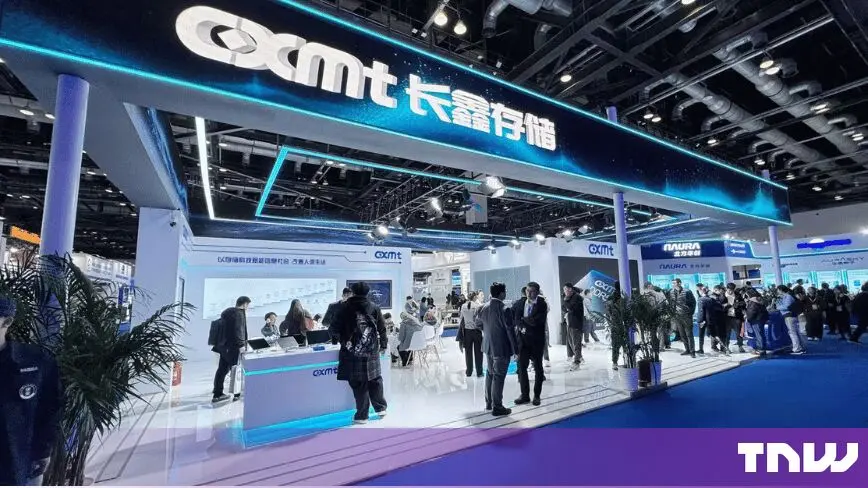
CXMT, one of the world’s largest memory chip makers, has sued the US Department of Defense in Washington to remove itself from a list identifying it as a Chinese military company. The lawsuit, filed in a federal court in Washington, names Defense Secretary Pete Hegseth as the defendant. The designation under Section 1260H of the National Defense Authorization Act prevents the company from receiving US defense contracts, but it does not immediately ban commercial sales.
The company, formally known as ChangXin Memory Technologies, is headquartered in Hefei, Anhui province, and is China’s most advanced DRAM maker. In a statement, CXMT said it is not a military company and has no affiliation with the Chinese military. The company insists that it designs and manufactures memory chips for civilian and commercial applications, including personal computers, smartphones, and data centers.
The legal action is the latest front in the escalating competition between the United States and China over semiconductor technology. CXMT was first placed on the Pentagon’s list of “Chinese military companies” in January 2025. It briefly came off a version of the list in February, only to be added again in June, creating a legal and regulatory whiplash that has frustrated the company and its investors.
What the 1260H designation means
The Pentagon’s Section 1260H list is often described as a “red flag” mechanism. Companies placed on it are barred from supplying the US Department of Defense, and they may also face enhanced scrutiny from American investors and partners. However, unlike the Entity List maintained by the US Commerce Department, a 1260H listing does not automatically prohibit the sale of commercial products to non-US buyers.
For CXMT, the designation is more than a bureaucratic inconvenience. Industry analysts have repeatedly noted that being placed on the 1260H list is frequently a preliminary step before more severe export controls are imposed. The Entity List, by contrast, requires US suppliers to obtain a special license to sell technology or components to the designated company, and those licenses are often denied for Chinese semiconductor firms.
The company’s lawsuit argues that the Pentagon’s decision was arbitrary and unsupported by evidence, and it seeks a court order compelling the department to remove CXMT from the list. Legal experts say the case could set a precedent for other Chinese companies that have been designated under the same provision but dispute the Pentagon’s characterization.
CXMT’s rapid rise
The lawsuit arrives at a time of remarkable commercial success for CXMT. The company is now the world’s fourth-largest producer of DRAM chips, behind only Samsung, SK hynix, and Micron Technology. DRAM is a critical component in computers, servers, and mobile devices, and it has become a strategic asset in the global technology rivalry.
CXMT listed its shares on the Shanghai Stock Exchange’s STAR Market on July 27, 2025, at a price of 8.66 yuan per share. On the first day of trading, the stock opened 471 percent above its initial offer price. The IPO quickly made CXMT one of the most valuable listed companies in China. Within seventeen days, its market capitalization surpassed that of Tencent, making it the most valuable listed company in the country at roughly 3.54 trillion yuan, or about 500 billion US dollars.
That valuation reflected a wave of enthusiasm for domestic semiconductor champions as Beijing pushes for self-reliance in advanced chip technology. It also reflected the global shortage of memory chips, which has driven DRAM prices sharply higher.
The memory price surge
DRAM prices have quadrupled over the past three quarters. The primary cause is the sudden shift of production capacity by the three dominant manufacturers — Samsung, SK hynix, and Micron — toward high-bandwidth memory used in AI data centers. Artificial intelligence workloads require enormous amounts of fast memory, and the existing supply pool for mainstream DDR4 and DDR5 chips has tightened considerably.
That price surge has been a financial windfall for CXMT. As the only significant Chinese DRAM producer, it has been able to sell its products at premium prices while also gaining market share from customers who are wary of supply-chain disruptions. Apple, for instance, has been testing CXMT memory chips for devices sold in China, according to reports. This would mark a major expansion for CXMT, which currently sells most of its output to Chinese electronics companies.
Europe’s quiet dependency
While the legal battle is centered in Washington, its implications extend far beyond the United States. Europe has no volume DRAM manufacturing at all. Every memory chip used in a European product must be imported, whether from Asia or the United States. This makes European industries — from automotive and industrial electronics to cloud computing and telecommunications — vulnerable to both price swings and regulatory decisions made in other capitals.
There is no European equivalent of the Pentagon’s military company list. But American export controls reach European supply chains anyway. When the United States restricts a Chinese company, European manufacturers that rely on components from that company are indirectly affected. The Chinese government has repeatedly warned that wider export restrictions on semiconductor equipment would break the equipment chain for everyone, including Western companies.
The CXMT case is therefore being watched closely in European boardrooms and policy circles. A designation as a Chinese military company may not stop European firms from buying CXMT memory, but it raises a difficult calculation. Investors in Europe are increasingly wary of touching companies that carry what the Americans call “military end-user” risk, and banks are cautious about financing deals that might run afoul of sanctions or export-control regimes.
Geopolitical and business implications
The lawsuit also reflects a broader shift in how Chinese companies are defending themselves against US regulatory action. Rather than quietly accepting designations and trying to work around them, a growing number of Chinese firms have chosen to sue the US government. While the outcome of such lawsuits is uncertain, they provide a platform for the companies to challenge the factual basis of American national-security decisions and to engage with the US legal system on their own terms.
For CXMT, the timing of the lawsuit is also significant. The company has just completed a successful IPO and is expanding its production capacity. It is also starting to compete more directly with world leaders in DRAM technology. Being labeled a military company could hinder its ability to work with foreign partners, especially in Europe and Japan, where it needs access to equipment and materials to produce advanced chips.
The company’s legal team is expected to argue that the Pentagon failed to provide sufficient evidence to support the designation, and that the decision violates the company’s right to due process. Similar arguments have been made by other companies that have appeared on the 1260H list, including Chinese telecommunications and drone makers, but few have pursued litigation all the way to trial.
The quiet part
For European observers, the most striking aspect of the CXMT lawsuit is what it says about the state of the global semiconductor market. The list that CXMT is fighting is American-written. The memory chips that CXMT sells are Chinese-manufactured. But the cost of the disruption — higher prices, supply uncertainty, and the constant threat of new restrictions — is felt in euros, yen, and won as much as in dollars and yuan.
European policymakers have not yet publicly said whether they consider it acceptable for European companies to buy memory chips from CXMT or any other Chinese supplier. Nor have they asked the question in a formal way. The lawsuit forces the conversation into the open by reminding every company that uses DRAM chips that the rules of the game are being written by governments, not by the market.
As the case moves through the US federal court system, the implications will extend far beyond CXMT’s own listing status. If CXMT wins, it would prove that Chinese companies can successfully challenge American national-security designations, potentially opening the door for other Chinese tech firms to do the same. If CXMT loses, the designation will stand, but the company will have made a public record of its rejection of the American narrative — a record that its lawyers may use in future legal battles in other jurisdictions.
For the moment, CXMT remains free to sell its chips worldwide, and its customers remain free to buy them. But the litigation casts a shadow over every future commercial transaction involving the company. The mundane language of Section 1260H, with its references to defense contracts and lists, masks a much larger geopolitical contest over who gets to make the world’s most crucial semiconductor components — and who gets to decide who is eligible to participate.