

Keeping a car in good working order takes more than regular oil changes and new windshield wipers. The engine bay is a demanding environment: it absorbs heat, vibrations, road grime, moisture, and a fine film of oil that slowly works its way onto hoses, wiring, metal surfaces, and the block itself. That kind of accumulation is not just an eyesore. It can hide fluid leaks, accelerate rubber degradation, make electrical connections less reliable, and even cause engine components to run hotter than they should. A clean engine bay is one of the simplest ways to monitor your car's health, and it can make normal maintenance jobs far easier.
Most households know WD-40 as the odoriferous spray used to silence a squeaky hinge or loosen a rusty bolt. That familiar can is useful, but WD-40's Specialist line goes much further. It offers cleaning and degreasing products designed specifically for automotive work, including heavy-duty engine cleaners, rubber-safe degreasers, carbon deposit removers, electrical contact cleaners, and a precision pen for tight spaces. Each product has a specific job inside an engine compartment. Choosing the wrong cleaner can leave residue on a sensor, cause rubber to dry out, or create an issue with an electrical connector. Knowing what each formulation is designed for makes all the difference.
Before using any of them, take a few precautions. Allow the engine to cool completely. Hot engine parts and solvents are a bad combination. Cover sensitive components such as the alternator, air intake opening, fuse box, and exposed connectors with plastic wrap or a plastic bag. It is also helpful to disconnect the negative battery cable unless you are cleaning the battery itself. These simple steps help ensure that you can clean thoroughly without creating a new electrical problem.
WD-40 Specialist Machine & Engine Degreaser
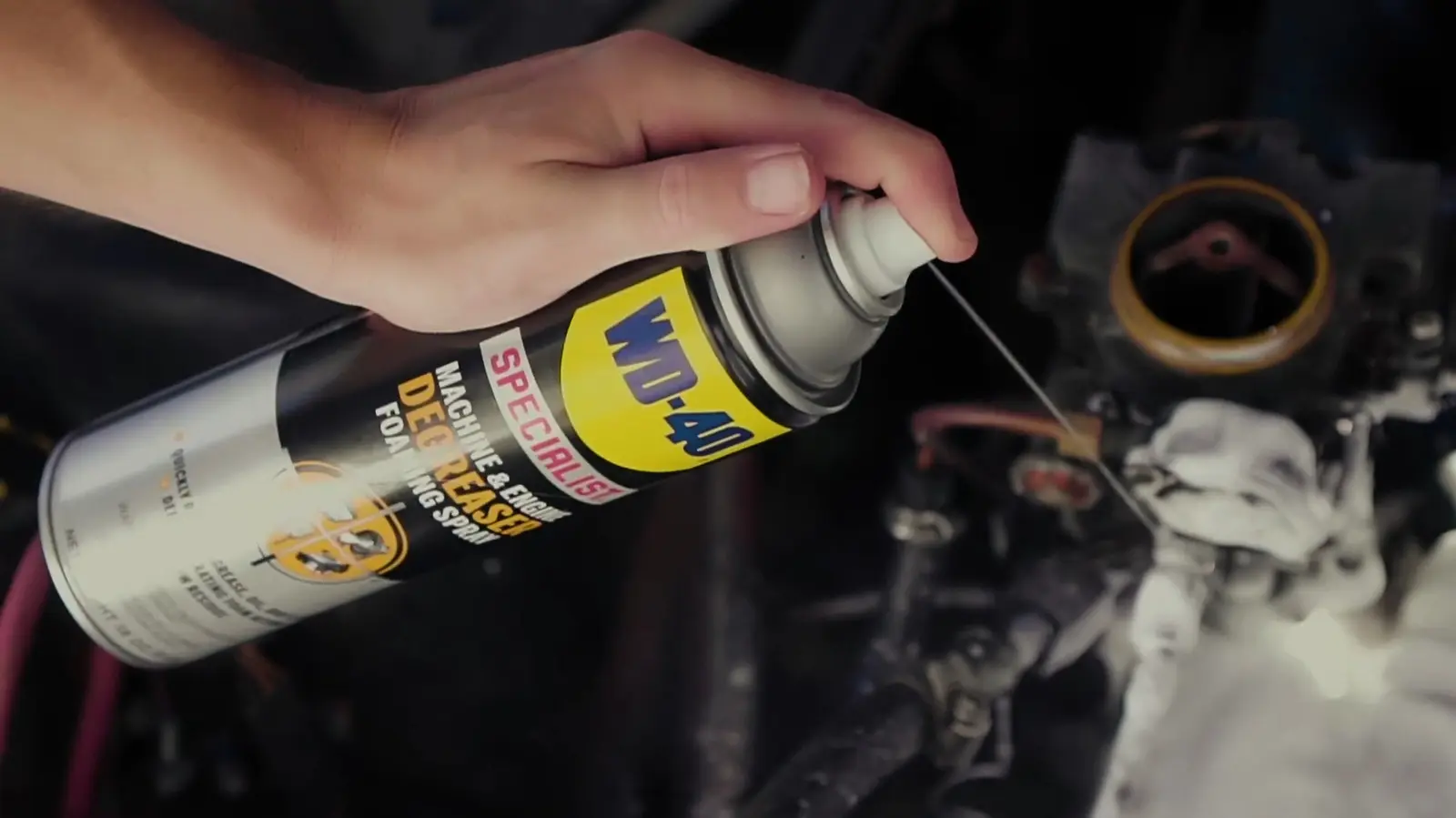
The WD-40 Specialist Machine & Engine Degreaser is the starting point for anyone who wants to return an engine block to a clean state. It is a foam spray that clings to vertical surfaces rather than running off immediately. The foam layers on top of baked-on oil, grease, and general grime, softening the material so that it can be rinsed or wiped away. This product is especially helpful for the metal engine block, valve covers, and nearby surfaces where oil tends to collect from small leaks or years of regular use.
Application is simple: spray the foam onto the areas with visible buildup, let it work for a few minutes, and then rinse thoroughly with low-pressure water or wipe the surface down. Since this is a degreaser, it should not be used directly on electrical connections, alternators, sensors, or the battery. If you spray it near such areas, cover them first. Also keep in mind that a high-pressure car wash wand can force water into connectors and intake pathways. A garden hose with a spray nozzle is often safer for rinsing. This product is an excellent general-purpose engine bay cleaner, and for many people it may be the only product needed for a regular maintenance clean.
WD-40 Specialist Degreaser
While the Machine & Engine Degreaser performs well on metal, an engine compartment is not made only of steel and aluminum. It also contains plastic covers, rubber coolant hoses, wiring looms, and composite components. These materials need a cleaner that is less aggressive while still powerful enough to dissolve the sticky film that forms on them. The WD-40 Specialist Degreaser is built for this broader group of surfaces. Its formula can be used on metal, rubber, plastic, and painted parts, which makes it a better choice when you are cleaning an entire bay rather than just the engine itself.
This degreaser is not a foam, so it is best used as a spray-and-wipe product. Spray it on the dirty area, let it sit for a moment, and then wipe it clean with a shop towel or microfiber cloth. It works well on the underside of the hood, plastic radiator fans, rubber intake boots, and hoses. Even though it is considered industrial strength, the product is still safe enough to wash off your hands with soap and water, and it will not damage most garage or household surfaces. Like any heavy-duty cleaner, it should still be kept away from electrical connections. If you pay attention to where you spray, this can serve as the versatile cleaner for almost every non-electronic surface under the hood.
WD-40 Specialist Carb/Throttle Body Cleaner
Oil and grease are not the only kinds of buildup that affect an engine. Carbon deposits can form on throttle bodies and carburetor components, especially in engines that have been driven mostly for short trips or that suffer from incomplete combustion. Carbon buildup can restrict airflow, upset the fuel-air mixture, and cause poor idle, hesitation, or lower fuel efficiency. The WD-40 Specialist Carb/Throttle Body Cleaner is designed specifically to handle those tenacious deposits without leaving a residue that could harm sensors or disrupt combustion.
This aerosol spray works through a dual-action process. The solvent first breaks down and loosens the carbon, then the propellant gives a burst of air that carries the dissolved residue away from the part. It is a fast-acting solution that can be used without fully disassembling the throttle body in many cases. For someone who prefers to work methodically, it can also be applied after removing the intake duct and throttle body to clean the plate, bore, and linkages carefully. The product is effective for carburetors as well, making it useful for older cars, motorcycles, and small engines. If you are dealing with rough idling or throttle response issues, cleaning carbon from these areas can be a meaningful maintenance step.
WD-40 Specialist Electrical Contact Cleaner
Modern engine bays are filled with electronics. The engine control module sends signals through dozens of connectors, the battery supplies electricity to more systems than most drivers realize, and sensors throughout the bay monitor temperature, air flow, oxygen levels, and more. These electrical connectors and terminals are vulnerable to the same moisture, oil, and road salt that create grime everywhere else. With time, corrosion can develop on battery terminals or inside wiring connectors, causing voltage drop, impossible-to-track electrical gremlins, and eventual component failure. The WD-40 Specialist Electrical Contact Cleaner is intended for exactly these sensitive parts.
It is safe on plastic, rubber, and metal, so you can spray some connectors without fearing that it will destroy their housings. This cleaner removes oil, grease, dirt, moisture, and light corrosion from electrical contacts. The most common use is to spray it directly on battery terminals before wiping them with a clean towel. It can also be used on harness connectors, grounding points, and fuse contacts. Because it evaporates quickly, it leaves a clean surface that is ready to make a solid electrical connection. If you are cleaning a component that you have already removed from the vehicle, you can let it air-dry rather than wiping it. This is especially useful for isolated sensors or relay contacts where you want to avoid moving contamination deeper into the part.
WD-40 Specialist Degreaser and Cleaner EZ-Pods
Garage storage space is always valuable. Buying separate spray cans for the engine bay, tools, and household cleaning can fill a shelf quickly. The WD-40 Specialist Degreaser and Cleaner EZ-Pods offer an answer for people who prefer a single, concentrated cleaning formula. These pods look like small dissolvable tablets. To use one, fill a 32-ounce spray bottle with water and drop in the pod. Once it dissolves, the bottle contains the same kind of cleaner that WD-40 sells in its aerosol and trigger bottles, but without requiring another large plastic container to take up space.
This solution works on a wide range of surfaces, including metal, concrete, rubber, plastic, and even some fabrics. That makes it useful for cleaning a dirty engine bay, wiping down tools, removing oil stains from a garage floor, or tackling a greasy household appliance. The cleaner is simple to use: spray it on the affected surface and wipe it off with a towel. While it is quite versatile, it is still wise to avoid spraying it on exposed electronics or wiring connectors. The pod system is also convenient because you can mix only what you need and dispose of the empty bottle without guilt. Many drivers like to keep one bottle of this diluted cleaner under the garage sink for tasks beyond the car as well as for routine engine bay wipe-downs.
WD-40 Precision Pen
Engine bay cleaning is not always about covering large surfaces. Some parts are small, tight, and difficult to reach with an aerosol spray, even when it includes a narrow nozzle. The WD-40 Precision Pen solves that issue with a needle-point applicator designed for precise control. It contains the original WD-40 formula that most people already know, but the pen-shaped applicator is much easier to guide into a cramped spot. You can place a single drop of lubricant exactly where you need it rather than overspraying half of the surrounding area.
This pen is helpful when you clean and then lubricate throttle cable ends, hood hinges, latches, and small metal brackets around the bay. It can also be used to chase out moisture from an exposed fastener or to put a thin protective layer of lubricant on hardware that is starting to show surface rust. The original formula also pushes out moisture and leaves behind a microscopic film that can help keep bare metal from rusting in the future. Because the pen fits neatly into a pocket or tool bag, it is practical for use in the garage, on a road trip, or anywhere you spot a stubborn fastener. Being precise inside the engine bay is not just about convenience; it is about preventing corrosion in the small places that often get ignored until they become a problem.
Source: SlashGear News