

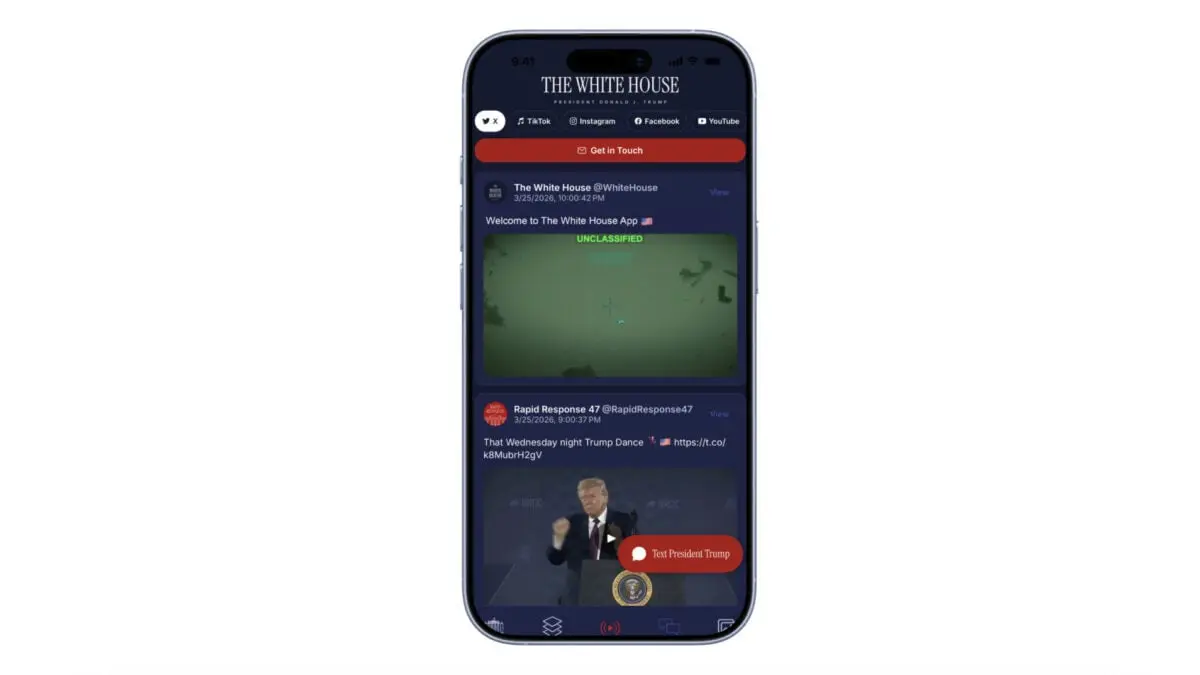
If you work for the Department of Homeland Security, an app is about to be auto-loaded onto your work phone, sort of like that U2 album that auto-loaded on everyone’s iPhone in 2014, except instead of delivering “Songs of Innocence,” the app claims to deliver “unfiltered, real-time updates straight from the source”—the source being Donald Trump.
The White House app, originally released in March and available on the App Store and Google Play, is now being pushed to all DHS-issued mobile devices. An email sent Tuesday, seen by Politico, informs employees that the app provides “a convenient way to access official White House communications, including announcements, executive actions, speeches, livestreams, videos and other updates.” The app’s description on the White House website highlights “breaking news alerts on major announcements, executive actions, and other key priorities” as its primary feature.
App Features and Data Privacy Concerns
The app’s features include video streaming, a library of archived Trump sound bites, a way to “stay connected” with new policies, and an option to send feedback, including by voice. However, an investigation by Notus.org found that the app shares user data—including time zone, IP address, and other identifying information—with third parties. According to Notus, the White House app “doesn’t disclose its data sharing the way most others do,” raising red flags among privacy advocates.
Security Implications for Government Devices
Last month, the Trump Administration instructed federal agencies to begin installing the app on their employees’ phones. At least one agency—the Federal Aviation Administration—was already scheduled to receive the app as an auto-download. This move has alarmed cybersecurity experts. Sonny Hashmi, a former IT executive for the General Services Administration, told Government Executive that auto-installs of the app are “cause for alarm.” Hashmi warned, “Any app that is installed on government issued devices can potentially create backdoor access to government networks behind the firewall.”
The Department of Homeland Security oversees critical infrastructure, border security, and emergency response. Forcing an app onto devices used by employees with access to sensitive systems could create attack vectors for malicious actors, particularly if the app’s security posture is not fully transparent. The White House has not publicly released a detailed privacy assessment or security audit for the app.
Historical Precedent: The 2010 White House App
This is not the first time the White House has released a mobile app. In 2010, under President Barack Obama, the White House launched an app that provided news, photos, and videos. While that app also collected some user data, its scope was far more limited. The Obama-era app did not include features like voice feedback or real-time alerts from the president, nor was it forcibly installed on government devices. The 2010 app lived in the era of the “there’s an app for that” bubble, when mobile apps were still a novelty. Today, however, concerns about data privacy and government surveillance are much more prominent.
The forced installation of the White House app on DHS devices touches on broader debates about the line between official communications and political messaging. Critics argue that the app is designed to amplify the president’s personal brand rather than provide neutral government updates. The app’s integration with third-party data-sharing partners also raises questions about whether DHS employees' data could be used for non-governmental purposes.
Reactions from the Tech and Policy Communities
Technology journalists and policy analysts have expressed skepticism. Many draw parallels to the controversy over the Trump administration’s earlier efforts to blur the line between official White House communications and campaign-style messaging. The app’s user agreement, which permits data collection across multiple platforms, has been described as unusually permissive. Privacy advocates are calling on DHS to allow employees to opt out of the automatic installation, and several lawmakers have requested a briefing on the app’s security protocols.
In the original news article, the author noted that the cover image for the piece—showing a post about “That Wednesday night Trump dance🕺🇺🇸”—was not chosen for mockery but rather because the White House itself provided that screenshot as an illustration. This choice underscores the app’s focus on personal, often informal content from the president, rather than dry policy statements.
Broader Implications for Federal IT Security
The auto-installation of the White House app comes at a time when federal cybersecurity is under intense scrutiny. Recent high-profile breaches—including the SolarWinds hack and the Colonial Pipeline ransomware attack—have highlighted vulnerabilities in government networks. Forcing a third-party app onto devices that access those networks, without a transparent security review, could introduce new risks. Hashmi’s comment about backdoor access is particularly worrying: if the app contains any hidden functionality, it could be exploited by foreign intelligence services or other adversaries.
Furthermore, the app’s data-sharing practices could conflict with existing federal regulations, such as the Privacy Act of 1974, which restricts how agencies can collect and share personal information. Legal experts note that while the White House itself is not an “agency” under the Act, DHS is, and any data collected from DHS employees through the app might be subject to limitations. However, without clear disclosures, it remains uncertain whether these regulations are being followed.
What DHS Employees Can Do
For DHS employees who receive the forced installation, options are limited. The email reportedly instructs employees to accept the installation; refusal could be seen as insubordination. However, employees can still attempt to limit the app’s permissions on their devices, such as disabling location tracking or background data usage. The app’s terms of service may allow the White House to access other data on the phone, but without a full audit, the extent of this access is unknown.
The debate over the White House app is likely to continue, especially as other federal agencies consider similar moves. The Trump administration has signaled that it views the app as a key communication tool, and further expansion to other departments could be forthcoming. Until then, DHS employees will have to live with a pre-installed app that brings the president’s messages—and potential privacy risks—directly to their work phones.
Source: Gizmodo News