

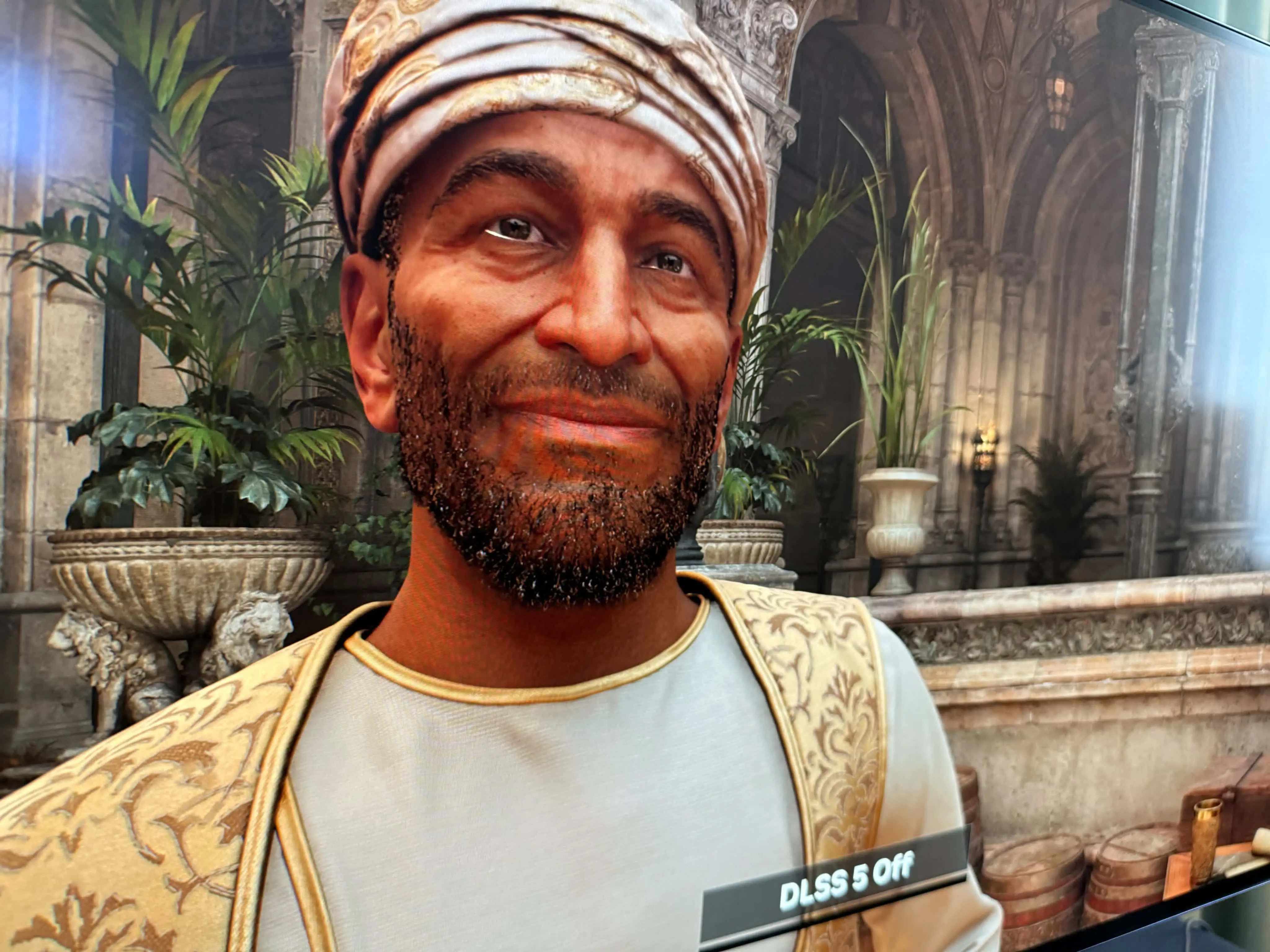
Nvidia unveiled DLSS 5 at GTC 2026, and the initial wave of social media reactions largely fixated on how characters' faces suddenly looked photorealistic. But after spending hours with the technology running on multiple titles, it's clear that the facial enhancement is just one part of a much broader visual revolution. The coffee maker in Starfield, the water in Oblivion Remastered, the foliage in Assassin's Creed Shadows, and the stone textures in the Zorah tech demo all received equally dramatic upgrades. Here's what DLSS 5 actually does—and why the 'face filter' label misses the point.
Key Facts at a Glance
- DLSS 5 uses a single unified AI model, not per-game or per-object training, to analyze the color buffer and motion vectors and enhance lighting and material response across the entire scene.
- The model recognizes different materials (skin, metal, water, stone, foliage) and applies physically appropriate lighting interactions to each.
- Improvements extend beyond characters: shadows, reflections, subsurface scattering on leaves, spatial depth of objects, and overall scene coherence all see significant gains.
- Developers receive granular control including per-material intensity sliders, spatial masking, and color grading settings—all via the existing SDK.
- First-wave games include Starfield, Assassin's Creed Shadows, Hogwarts Legacy, Oblivion Remastered, Resident Evil Requiem, and Phantom Blade Zero, among others.
- The demo system used two RTX 5090 GPUs, with one dedicated to the AI workload, but Nvidia expects to ship DLSS 5 on a single GPU for its fall 2026 launch.
What Makes DLSS 5 Different
For years, achieving photorealistic faces in real-time games has been one of the hardest problems in computer graphics. Subsurface scattering on skin, micro-detail in hair, and natural eye reflections require immense compute power—often so much that they can only be shown in isolated tech demos. DLSS 5 changes that by using a neural network that understands the semantics of the scene. It doesn't just upscale; it re-lights and re-materials.
The key innovation is that the same model works across all games. It takes the raw rendered color and motion vectors, analyzes what each part of the image represents, and then enhances the lighting and material properties accordingly. During the demo, toggling DLSS 5 on and off in Starfield revealed that environmental objects like a coffee maker, paper towels, and a napkin holder went from flat, game-like assets to objects with real volume, natural light wrapping, and convincing spatial relationships. The water in Oblivion Remastered transformed from a standard video game surface to something that could be mistaken for a real body of water.
This is possible because the AI model uses tens of thousands of examples of real-world light behavior to infer how the scene should look if rendered with full ray tracing and physically based materials. It's not adding arbitrary detail; it's recovering detail that the game engine couldn't afford to compute in the first place. The result is that every scene element benefits, not just characters.
The Developer Control Story
One of the most reassuring aspects of DLSS 5 is the level of control it gives to developers. Far from being a black box that applies a one-size-fits-all filter, the technology allows artists and engineers to dial in exactly how much enhancement they want for each material type. In the SDK, they can set water to 100%, wood to 30%, and character skin to 120%, all independently. They can also apply spatial masks, so that only certain parts of the screen receive augmentation, and they have full control over color grading, contrast, saturation, and gamma blending.
During the demonstration, Nvidia's researchers explained that when technical artists at partner studios previewed DLSS 5, many became internal advocates. The reason is that they saw a way to recover the look they had designed in their authoring tools—the look that inevitably gets lost when assets are squeezed into a real-time engine with a 16 ms frame budget. DLSS 5 effectively lets them get closer to their original artistic intent without sacrificing performance.
This developer-friendly approach has already secured commitments from major studios including Bethesda, CAPCOM, Ubisoft, Tencent, and Warner Bros. Games. The fact that these teams are willing to invest time in integration suggests they see DLSS 5 as a tool that respects their creative visions rather than overriding them.
Hardware Considerations
The demo rigs used two RTX 5090 GPUs: one handling the game rendering, the other entirely dedicated to the DLSS 5 AI inference. While this dual-GPU setup was only for the preview, Nvidia confirmed that the consumer launch later this year will run on a single RTX 5090. The AI model will share the GPU's compute resources with the rendering pipeline, much like current DLSS implementations.
Nevertheless, the dual-GPU demo highlights an interesting architectural concept. For years, multi-GPU gaming has been effectively dead due to the demise of SLI and CrossFire. But here, a second GPU running a pure AI workload produces a visually dramatic improvement. It's plausible that as neural rendering matures, dedicated AI processors—whether on the GPU or separate—could become a standard part of high-end gaming systems. For now, Nvidia is confident that a single RTX 5090 can deliver the full DLSS 5 experience at launch.
It's also worth noting that DLSS 5 works across rendering backends. Whether a game uses classic rasterization, ray tracing, or fully path-traced lighting, the AI model amplifies the output. The higher the base quality, the better the final result, but even games using standard rasterization see notable improvements in lighting and material perception.
Looking Ahead
The fall 2026 launch window gives developers several months to integrate and optimize DLSS 5. The first wave of titles already looks impressive, but the technology's true potential will only be realized as studios explore the fine-grained controls and tailor the enhancement to their specific art styles. Given the positive early reactions from technical artists and the precedent set by previous DLSS iterations, it seems likely that DLSS 5 will become a standard feature for high-fidelity PC gaming.
Neural rendering represents a paradigm shift. Instead of brute-forcing every pixel with more ray tracing and compute, AI can intelligently fill in the gaps left by constrained budgets. The result is a consistent, high-quality visual experience across the entire frame—not just faces. The next time you see a side-by-side comparison, look at the coffee maker.
Source: TechSpot News