

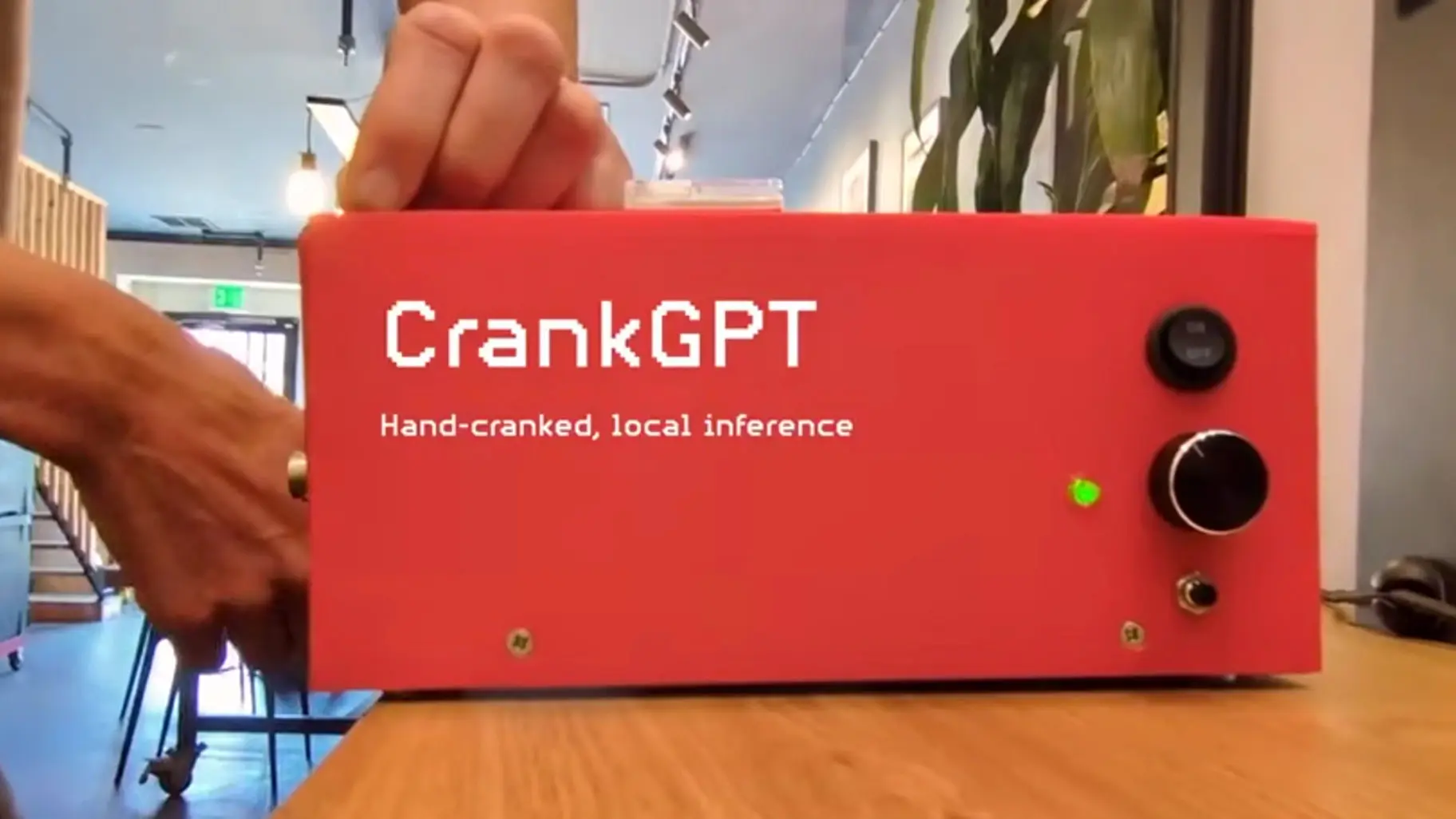
The rise of generative AI has brought powerful tools like ChatGPT and Google Gemini into everyday use, but it has also raised concerns about energy consumption and environmental impact. A Europe-based startup, Squeez Labs, has unveiled a novel solution: CrankGPT, a fully private AI chatbot that runs entirely on manual power. No batteries, no wall outlet—just a hand crank that generates the electricity needed to process queries and produce answers.
At its core, CrankGPT is a compact device housing a Raspberry Pi 5 with 8GB of RAM, connected to a 20W hand-crank generator. When a user turns the crank, mechanical energy is converted into electrical power, which instantly runs the system. This design eliminates the need for any stored energy or cloud connectivity, making the device both private and self-sufficient. The creators emphasize that the crank powers all processes: speech recognition, language model inference, and audio output via the Piper voice model. Small language models are recommended, such as the 350M-parameter or 1.2B-parameter variants of Liquid AI's LFM2, or Google's Gemma 1B model. These models are lightweight enough to run efficiently on the Raspberry Pi, ensuring that responses come quickly despite the limited power budget.
One of the most compelling aspects of CrankGPT is its privacy. Because everything runs locally, users' conversations never leave the device. There is no internet connection required, so no data is sent to external servers. This contrasts sharply with mainstream chatbots, which often rely on cloud processing and can raise privacy concerns. For individuals wary of data collection or those in areas with unreliable internet access, CrankGPT offers an alternative that puts control firmly in the user's hands—literally.
The device is not silent, as the video demonstrations show. The crank and cooling fan produce noticeable noise, but the creators argue that this is a small trade-off for a device that is both private and energy-efficient. They have tested it for generating images, poetry, and even code, though it performs best on simple everyday queries like answering trivia, setting reminders, or composing short messages. When the system is under heavy load—simultaneously running speech synthesis and large language model inference—the crank becomes harder to turn, reflecting the increased power draw.
Beyond privacy, the environmental angle is central to CrankGPT's mission. The creators, inspired by a sensibility for practical, resource-conscious design (as they put it, "European small-practical-car sensibilities"), wanted to challenge the trend of throwing massive computational resources at tasks that smaller models could handle. Large data centers that power mainstream AI consume vast amounts of electricity and water for cooling. While CrankGPT does not address the energy used in training those models—which remains a significant environmental burden—it aims to reduce the energy footprint of inference, the process of generating responses after a model has been trained. The hope is that if more people adopt efficient local AI, the cumulative energy savings could be meaningful.
From a technical standpoint, the hand crank generator is a clever choice. It provides a steady 20W output when turned manually, which is sufficient to run the Raspberry Pi 5 along with the connected microphone, speaker, and display (if any). The device includes a small cooling fan to dissipate heat from the processor during intensive tasks. Early testers have reported that a minute of cranking can sustain several minutes of idle operation, but active conversation requires continuous cranking. This design ensures that the system only consumes energy when the user is actively engaging with it—no standby power drain whatsoever.
The developers have not announced a retail price or a production timeline. For now, the project exists as a concept and a working prototype. The company is accepting requests for demonstrations, likely to gauge interest and gather feedback. Given the niche appeal—a manually powered AI chatbot—it may not disrupt the market dominated by tech giants, but it serves as an important proof of concept. It shows that AI can be made accessible without relying on massive server farms and that privacy need not come at the cost of convenience.
In a broader context, CrankGPT joins a growing movement toward edge computing and frugal AI. Researchers and hobbyists have been experimenting with running small language models on devices like smartphones, laptops, and single-board computers. Projects such as Llama.cpp and Ollama have made it possible to run quantized versions of models like Llama 3 and Mistral on modest hardware. CrankGPT takes this a step further by adding an off-grid power source, making it suitable for outdoor use, emergency scenarios, or remote areas without electricity. Imagine a field researcher needing to query geological data, or a journalist in a disaster zone wanting to draft reports without internet—CrankGPT could be a resilient tool.
Of course, limitations abound. The hand crank is physically demanding; prolonged use may be tiring. The small models offer less accuracy and creativity than their larger counterparts. The device cannot access current information from the web, as it has no internet connection by default. And the noise might be distracting in quiet environments. Yet these constraints are intentional, forcing a focus on essential tasks and mindful consumption. It raises the question: Do we always need instant access to vast AI capabilities, or can simpler, slower, locally-run systems suffice for many everyday needs?
The environmental argument is particularly striking. Training a single large model like GPT-4 is estimated to emit hundreds of tons of CO2, and each query made to a cloud-based chatbot uses energy in data centers. While CrankGPT's hand crank avoids emissions during use, the energy still comes from the user's physical effort—which might be fueled by food rather than fossil fuels. Some may see it as a gimmick, but it underscores the fact that AI is not inherently clean; the infrastructure behind it has real costs. By offering a zero-emission inference device, Squeez Labs hopes to spark conversations about sustainable AI design.
As AI becomes more embedded in daily life, the trade-offs between convenience, privacy, and environmental impact will come into sharper focus. CrankGPT is a small experiment that points toward a possible future where AI can be both personal and planet-friendly. Whether it ever reaches store shelves or remains a thought experiment, it has already succeeded in one goal: making people reconsider what an AI device really needs.
Source: Android Authority News