

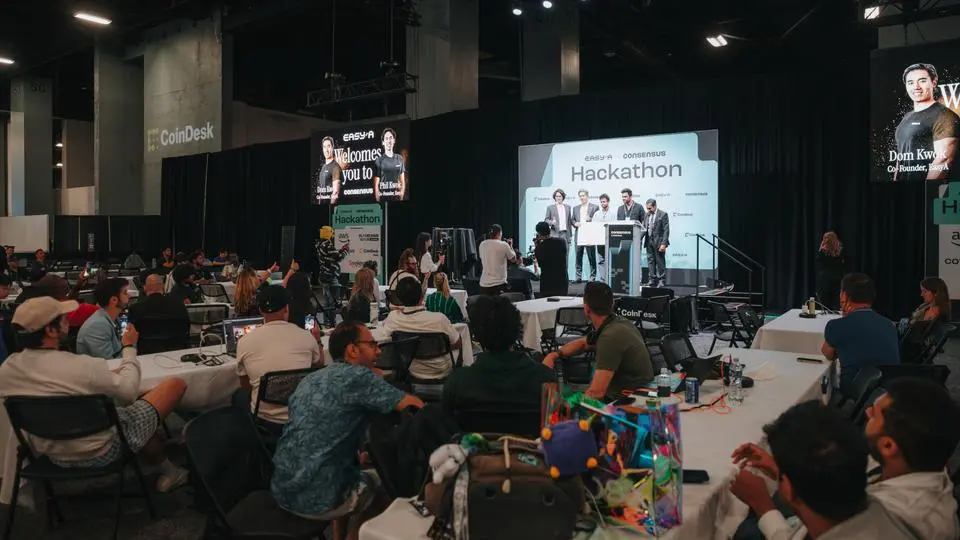
The Consensus Miami 2026 EasyA Hackathon turned into a high-energy startup factory as nearly 1,000 developers converged on the venue, most racing to build products around the theme of AI agents. The event, which has grown significantly from earlier coding competitions, now serves as a launchpad for crypto-native innovations that blend artificial intelligence with blockchain technology.
Key Facts from the Hackathon
Developers from major crypto ecosystems like Base and Solana participated alongside engineers from traditional tech giants Microsoft and Google. The resulting projects covered a wide range of applications, including autonomous payment systems, consumer-facing apps, hardware generation tools, drone coordination platforms, and prediction markets. The dominance of AI agents as the central theme reflects a broader industry shift toward autonomous, intelligent systems capable of executing complex tasks without human intervention.
The Evolution of EasyA
EasyA founders Dom and Philip Kwok emphasized that the hackathon has evolved from a simple coding competition into a proving ground for billion-dollar startup ideas. They noted that past participants have gone on to raise major venture capital funding, enter prestigious accelerators like Y Combinator, and build companies now valued in the billions. This success story is a testament to the quality of talent and the focus on practical, market-ready solutions that the hackathon fosters.
AI Agents in Crypto: A Growing Trend
The surge of AI agent projects at Consensus Miami is part of a larger movement within the cryptocurrency space. AI agents are autonomous programs that can learn, adapt, and execute tasks based on predefined goals. In the context of crypto, they are being used for automated trading, decentralized finance (DeFi) management, on-chain data analysis, and even creative content generation. The hackathon showcased how these agents can be combined with smart contracts, oracles, and decentralized storage to create entirely new business models.
Notable Projects and Themes
Among the standout projects, autonomous payment systems allowed users to set up recurring crypto payments triggered by AI agents, eliminating the need for manual intervention. Consumer apps leveraged AI to personalize user experiences in wallets and dapps. Hardware generation tools used AI to design and optimize blockchain mining rigs or IoT devices. Drone projects integrated AI agents with on-chain verification for delivery and surveillance. Prediction markets built on AI agent accuracy to improve betting and forecasting outcomes.
Historical Context and Impact
The EasyA Hackathon's history is rich with success stories. Previous winners have turned their prototypes into viable startups, attracting millions in funding from top venture firms. For example, a past project focusing on decentralized identity management later spun off into a company that now serves several major enterprises. Another team that built an AI-powered portfolio optimizer is currently part of Y Combinator's accelerator program. These examples underscore the hackathon's role as a critical first step for ambitious founders.
Broader Industry Implications
The emphasis on AI agents at Consensus Miami mirrors broader trends in the tech world. As large language models and other AI technologies become more accessible, developers are increasingly integrating them into blockchain applications. This convergence promises to unlock new efficiencies and capabilities, from automated auditing of smart contracts to personalized DeFi strategies. However, it also raises questions about security, governance, and the potential for unintended behaviors in autonomous systems. The hackathon's focus on practical building helps address some of these concerns by encouraging developers to consider real-world implications from the start.
The event also highlighted the growing collaboration between crypto natives and engineers from traditional tech companies. Microsoft and Google employees brought experience in cloud infrastructure, machine learning, and large-scale system design, while crypto developers contributed deep knowledge of blockchain protocols, tokenomics, and decentralized governance. This cross-pollination of skills is likely to accelerate innovation in both fields.
Conclusion of the Event
The Consensus Miami EasyA Hackathon demonstrated that the combination of AI and crypto is more than a buzzword—it's a fertile ground for new startups. With nearly 1,000 participants building adjacent to each other, the energy was palpable. Many teams expressed plans to continue developing their projects beyond the hackathon, seeking seed funding and beta users. The Kwok brothers' vision of the event as a launchpad for the next generation of unicorn companies appears well on its way to being realized.
In the weeks following the hackathon, several teams have already announced partnerships with established protocols in the Base and Solana ecosystems. Others are preparing to launch their products on testnets, aiming for mainnet deployments by the end of the year. The ripple effects of this event are likely to be felt for years to come, as the projects built here mature and enter the broader market.
Source: Coindesk News